How do you put in eye drops in space? A remarkable patch developed by Korean researchers [Health LAB]
- Input
- 2026-10-22 06:00:00
- Updated
- 2026-10-22 06:00:00
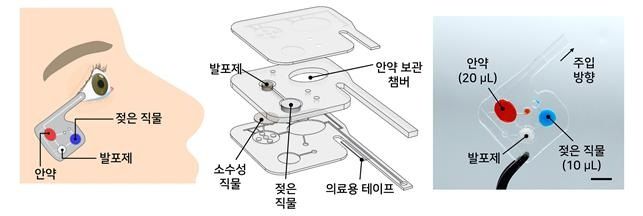
According to the Korea Advanced Institute of Science and Technology (KAIST) on the 22nd, a research team led by Professor Jeong Gi-hun of KAIST’s Department of Bio and Brain Engineering jointly developed a wearable eye-drop delivery patch designed for the constraints of the space environment with a team led by Professor Woo Se-jun of Seoul National University Bundang Hospital.
The patch developed by the research team combines, in a single flexible patch, a tiny channel through which liquid flows and a device that generates pressure through a chemical reaction. When the wearer presses the activation area, gas pressure generated inside the patch delivers eye drops to the eye.
The patch works through a reaction between vitamin C and baking soda. When ascorbic acid, a form of vitamin C, and sodium bicarbonate, the main ingredient in baking soda, come into contact with water, carbon dioxide gas is generated. The resulting pressure pushes the eye drops along the tiny channel. Rather than using gravity to make the drops fall, the patch uses pressure generated inside it.
A filter was placed between the space where the chemical reaction occurs and the space containing the eye drops. It allows gas to pass through while blocking liquid. This structure keeps the reactants separate from the eye drops while transmitting the gas pressure. The researchers say the patch could be useful in environments where equipment use is limited, since it requires no external pump or electrically powered device.
The research team confirmed that the patch maintained consistent eye-drop delivery performance under conditions with different gravity directions. In evaluations conducted while people wore the patch, its drug-delivery performance was comparable to that of conventional eye-drop administration. This demonstrated the potential of an eye-drop delivery method unaffected by the direction of gravity. Further testing is needed to verify whether it can be used in the actual space environment, the researchers said.
The patch could also have applications on Earth. It is expected to help people administer eye drops, including those with tremors, such as people with Parkinson’s disease, or those whose physical limitations make it difficult to position and operate an eye-drop bottle over their eyes.
Professor Jeong Gi-hun said, “The flexible eye-drop delivery patch developed in this study is a wearable platform that can deliver medication without separate, complex equipment. We expect it could be developed into medical technology for a range of settings, including space medicine.”
The results of the study were published online on October 7 in the international journal Sensors and Actuators B: Chemical.
[email protected] Yeon Ji-an Reporter