“Can’t leave work even after filming wraps” ... Drama and entertainment staff face grueling 84.8-hour workweeks
- Input
- 2026-10-21 16:22:50
- Updated
- 2026-10-21 16:22:50
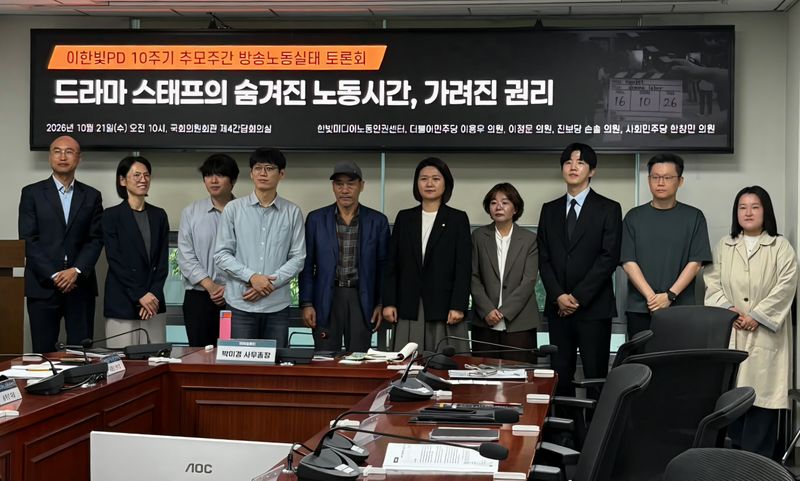
The Hanbit Media Labor Human Rights Center, Democratic Party of Korea lawmaker Lee Yong-woo, Progressive Party lawmaker Son Sol and others held a forum titled “The Hidden Working Hours of Drama Staff, Their Concealed Rights” on the 21st in Conference Room 4 of the National Assembly Members’ Office Building in Yeouido, Seoul. The forum was organized to discuss labor conditions in broadcasting production and ways to improve them, marking the 10th anniversary of the death of producer Lee Han-bit.
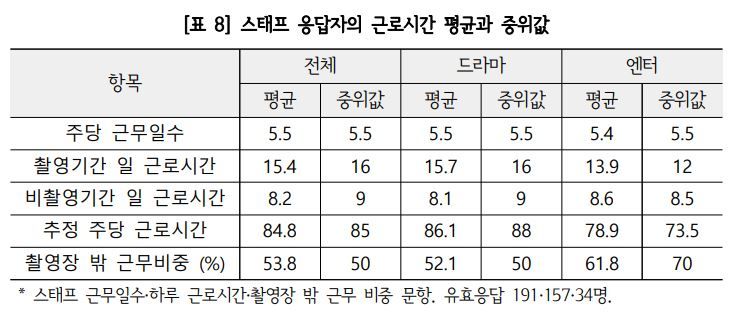
According to a survey released by Song Ha-min, deputy director of the center, 191 staff members at team-member level among 223 costume, makeup, art and props workers in the drama and entertainment sectors who took part in a survey last July and August were estimated to work an average of 84.8 hours a week during filming. The figure was calculated based on respondents’ reported number of workdays per week and hours worked per day.
Song said, “They start working one to two hours before filming begins and continue working after it ends, but they are not compensated for that additional work,” arguing that “preparation, travel and wrap-up work inside and outside filming locations must also be recorded and factored into wages, production schedules and staffing.”
In the same survey, 136 staff members (71.2%) said they had experienced an injury or illness at work. Of those, only 11 (8.1%) said their treatment costs had been covered by workers’ compensation insurance.
Kim said that workers “are exploiting themselves because they see this as work they love,” and pointed out, “We must first change the mindset that regards long hours as dedication or a necessary evil. The industry’s difficulties should not be overcome by returning to the long working hours of the past.”
Choi Min, a standing activist at the Korean Institute for Occupational Safety and Health, also suggested that “the 52-hour workweek has come to be treated as the norm rather than a ceiling,” adding that “filming should be scheduled within 40 hours a week, so that the work can be completed within 52 hours even when preparation and wrap-up tasks are included.”
Lee Yong-gwan, the father of producer Lee, said, “High-quality content can be produced only when the workers who create it are treated with dignity and have their futures secured.” He urged the relevant government ministries to stop passing responsibility from one to another and work to improve labor conditions.
Government representatives at the forum noted the need to strengthen labor inspections and expand the use of written contracts. Lee Chan-ung, a secretary in the Labor Standards Policy Division of the Ministry of Employment and Labor, said, “Labor inspections must adequately reflect new forms of work and employment and fragmented working hours,” adding, “We are considering how to oversee blind spots in labor law in sectors where disguised contracts in the form of freelance agreements are widespread.”
Heo Gwon, an administrative officer in the Video and Broadcasting Content Industry Division of the Ministry of Culture, Sports and Tourism, took a cautious stance on consolidating various types of standard contracts into a single employment contract. He said, “A range of contracts are used in the field in addition to employment contracts. If only an employment contract is presented as the standard, it is difficult even to provide people working under freelance contracts with a benchmark for comparing whether their contracts are fair.” He explained, “Since verbal agreements are still common, the immediate goal is to establish the practice of signing written contracts.”
[email protected] Park Seong-hyun Reporter