Park Young-sun: “AI capabilities will determine which SMEs win ... They need factories that produce intelligence”
- Input
- 2026-10-21 14:52:31
- Updated
- 2026-10-21 14:52:31
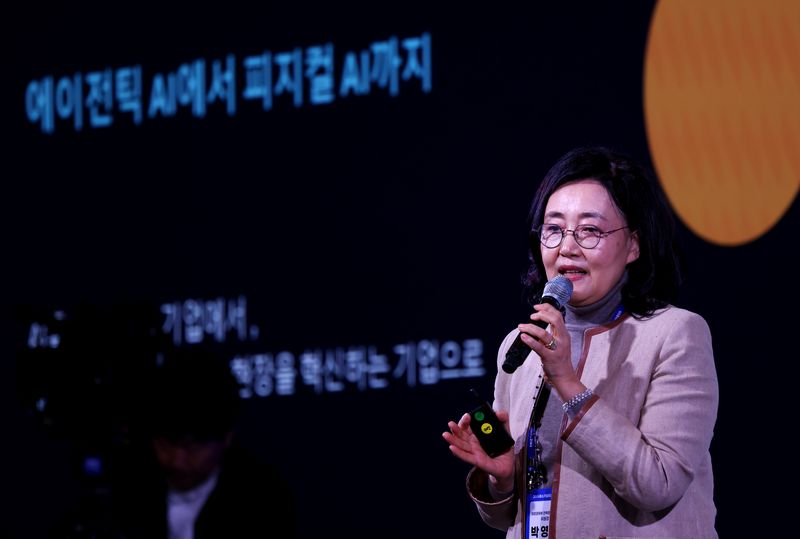
[Jeju = Lee Jumi, Reporter]“As long as a company remains hierarchical, it cannot realize 100% of the benefits of adopting artificial intelligence (AI). Even if AI produces a report in five minutes, if it takes an employee a day to read it and report it to a superior, there is no longer any reason to use AI.”
■ Linking manufacturing data to build competitiveness in physical AI
Park Young-sun, chair of the Ministry of Finance and Economy’s Strategic Economic Advisory Group and a former minister of SMEs and Startups, made the point in her keynote address at a policy discussion at the “2026 SME Leaders Forum,” held at Lotte Hotel Jeju on the 21st, stressing that “organizations need to become more horizontal to increase the benefits of AI adoption.”
Park assessed that AI technology is evolving from generative AI through agentic AI to physical AI. The argument is that SMEs, too, need to innovate their work and manufacturing operations to respond to this new trend toward agentic and physical AI.
Park stressed that “companies need to move beyond simply adopting AI and become companies that work alongside AI and innovate their operations,” adding that “to collaborate with AI agents, they first need to change their existing organizational structures and ways of working.”
She stressed the importance of standardizing and connecting data as key tasks for using AI. To that end, she pointed to the need to build “K-ontology,” a Korean AI data standard. An ontology is a framework that defines relationships among different types of data—such as people, organizations, tasks, documents and systems—so that AI can understand and use them.
Park stressed that “physical AI should be rolled out in stages based on connected manufacturing data, and ‘AI factories’ that turn data into intelligence should be established as a new production base,” adding that “ontology will determine whether physical AI succeeds.” She went on to explain that “every company needs to have two factories: one makes products, and the other makes intelligence.” She also stressed that “even when producing the same products, a company’s competitiveness will depend on how advanced the AI technology it develops is.”
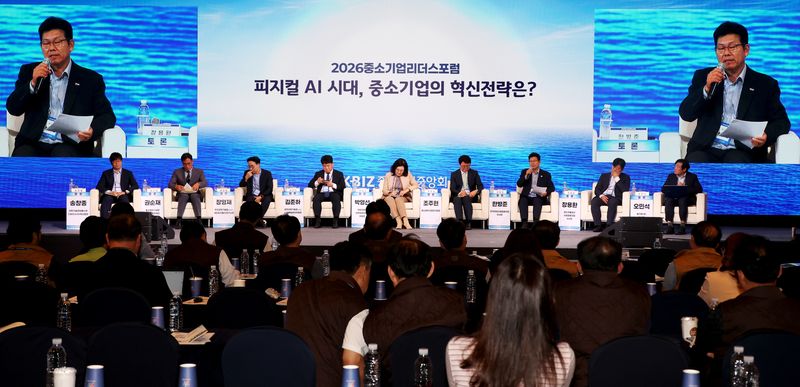
Kim Jun-ha, dean of the GIST Graduate School of AI Policy and Strategy, said that “the key competitive edge in the era of physical AI lies in process data and skilled know-how accumulated on manufacturing floors,” and stressed that “data must be made into an asset that AI can use, rather than simply collected.”
To this end, Kim proposed a system for sharing responsibilities: individual companies would accumulate data, cooperatives would establish common standards and a basis for joint validation, and the government would provide supporting infrastructure.
Cho Joo-hyun, president of the Korea Small Business Institute (KOSBI), proposed ways to reduce individual SMEs’ investment burden and risk of failure through collaborative innovation, including shared AI initiatives by cooperatives. He stressed the need to clarify data rights and responsibilities, as well as contract terms arising during AI adoption, and to spread the results of pilot projects by leading companies to other SMEs.
Meanwhile, ahead of the discussion, Ki-Moon Kim, chairman of the Korea Federation of Small and Medium Business, presented Park with “SME AI Transformation: Voices from the Field and Policy Challenges,” a report on on-the-ground difficulties and policy needs arising as SMEs adopt AI.
Chairman Kim said that “SMEs’ technologies and experience should be turned into data that AI can use and connected to physical AI, so that tacit manufacturing know-how built up over decades can be carried forward.” He added that “stage-by-stage support policies suited to SMEs’ capabilities should be designed so they can participate as drivers of the AI transformation, and AI should be rapidly adopted with industry-specific cooperatives as the hub.”
[email protected] Lee Jumi Reporter