A domestic alternative to Russia’s battery conductive-additive monopoly: Graphene ENG bets on cutting costs
- Input
- 2026-10-22 16:13:55
- Updated
- 2026-10-22 16:13:55
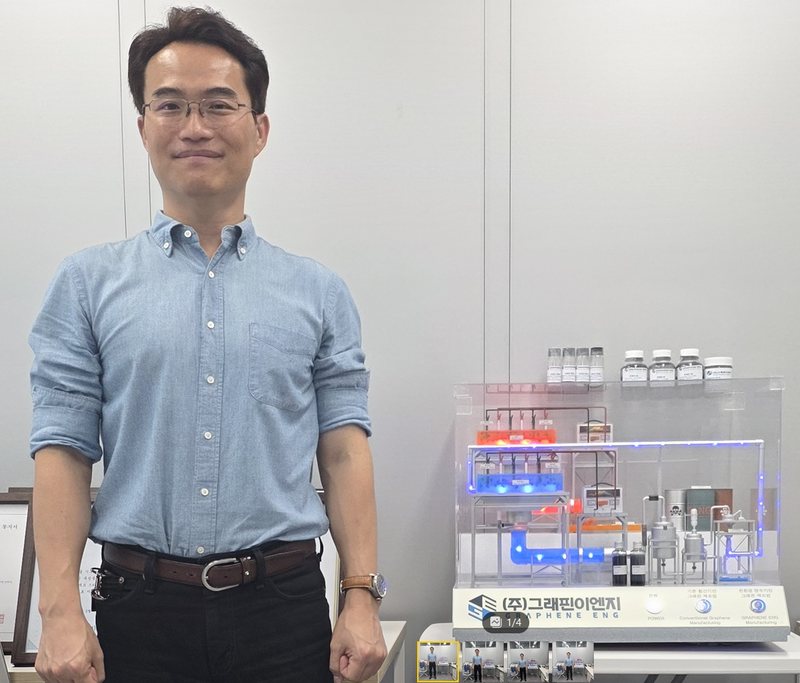
[Financial News] A startup has taken on the challenge of developing a substitute for the “conductive additive,” for which Russia controls at least 95% of global supply. It is Graphene ENG, founded in December 2023.
Graphene ENG CEO Lee Jae-young said on the 22nd, “We have developed a technology that uses graphene, a thin sheet, instead of single-walled carbon nanotubes (SWCNTs), which are shaped like slender tubes, to maintain electrical connections in silicon anode material, and we are on the cusp of commercialization.”
Graphite, the main component of pencil lead, consists of thin layers of carbon stacked on top of one another. Graphene is made by peeling away a single layer of carbon atoms. Thin, electrically conductive and flexible, graphene has attracted attention as a material for next-generation electronic devices and batteries.
Graphene plays an important role as a conductive additive in batteries. A conductive additive is an ingredient that creates pathways for electricity to flow between the particles that make up an electrode. Only a small amount is used in a battery, but it plays a key role in maintaining electrical connections between particles as the battery repeatedly charges and discharges.
This role is especially important in silicon anode material, a next-generation battery material. Anode material stores lithium ions during charging. At the same weight, silicon has about 10 times the theoretical capacity of graphite, which is widely used today. But as it takes in lithium, its volume can swell to as much as four times its original size. Repeated expansion and contraction damage the particles and break electrical connections, reducing battery performance.
A leading conductive additive used to address this problem is SWCNTs. Made of carbon, the extremely slender, tube-shaped material connects electrode particles like wires. However, a Russian company has been its exclusive supplier for more than a decade.
Lee developed a replacement for SWCNTs using graphene. But to apply it in industrial settings, the company also had to address manufacturing costs and production scale, in addition to performance. Lee saw cost competitiveness as the starting point for expanding the market. “Convinced that the market would open up only once graphene became affordable, I started by changing the manufacturing process,” he explained.
Lee, who had been struggling to expand the business, found a way forward through the Korea Industrial Complex Corporation’s “Industrial Complex Open Innovation (KICXUP)” program. Through the program, he was introduced to large companies interested in rechargeable-battery materials. The company is now validating performance with them under real-world application conditions. The next challenge is to reproduce the results achieved in the lab using customers’ materials and manufacturing processes as well.
The company is also working to secure intellectual property rights. It has built a technology portfolio that includes one patent registered in the United States and three registered in Korea.
Collaboration with customers is also ongoing. Last year, the company signed memorandums of understanding with multiple large companies and began joint proof-of-concept (PoC) testing to develop alternatives to nanomaterials currently sourced from overseas. The experiments are underway.
The next step is to expand production. Graphene ENG plans to raise a pre-Series A round this month and set up scale-up equipment by the first half of next year. It aims to reproduce its technology at consistent quality using larger equipment, while also securing supply contracts with customers and certified test reports.
In 2028, the company plans to build a large-scale commercial plant backed by Series A funding. Its goal is to increase production, lower the unit price of its products and establish a reliable supply base for customers.
“We will prove that domestic technology can produce longer-lasting silicon anodes and carry that effort through to a commercial plant by 2028,” Lee said.Jointly planned by Financial News and the Korea Industrial Complex Corporation[email protected] Kim Hyun-chul Reporter