Are consumers tightening their purse strings even during the year-end shopping season? Q4 retail outlook 'loses steam'
- Input
- 2026-10-21 12:00:00
- Updated
- 2026-10-21 12:00:00
[Financial News] Even with the year-end shopping season approaching, expectations for the retail sector in the fourth quarter have cooled somewhat amid more cautious household spending and the spread of value-conscious shopping.
Department stores and hypermarkets maintained their outlook for improving business conditions, but expectations at convenience stores and supermarkets weakened, revealing a clear divide among retail formats.
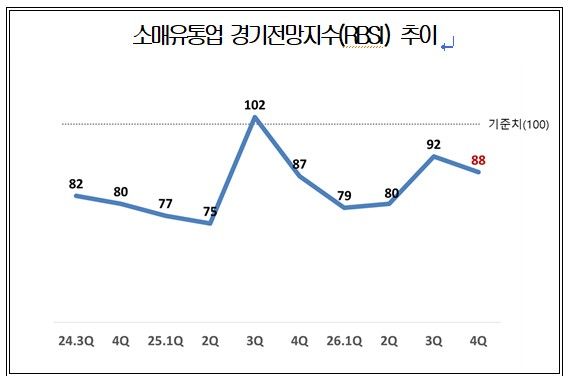
The Korea Chamber of Commerce and Industry (KCCI) announced on the 21st that its Retail Business Survey Index (RBSI) for the fourth quarter of 2026 stood at 88, based on a survey of 500 retail businesses in Seoul and the six major metropolitan cities.
That was down 4 points from 92 in the third quarter. A reading below 100 means more companies expect business conditions to worsen than to improve compared with the previous quarter.
The outlook index, which had rebounded on expectations of a boost from the summer vacation season and Chuseok, has stalled again. However, it remains above the five-year average of 83, suggesting a period of gradual adjustment rather than a sharp economic contraction.
Among the 203 businesses expecting conditions to worsen, 70.0% cited more cautious household spending as the biggest factor. A weak year-end shopping season effect followed at 8.9%, while customers shifting to other shopping channels accounted for 7.9%.
Consumers also continued to compare prices and buy only what they needed. Some 78.4% of respondents said their preference for value-for-money products was unchanged or had increased compared with previous years. The share of respondents who said purchases of only the necessary items—described as “small-quantity, purpose-driven buying”—was unchanged or had increased reached 83.6%.
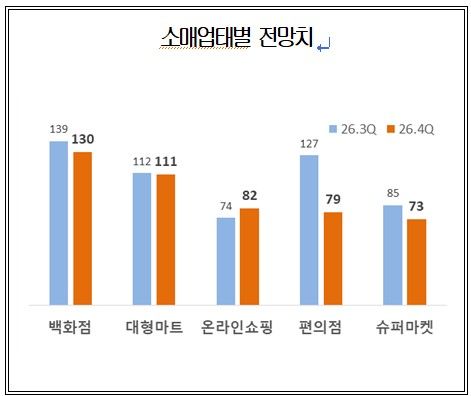
By retail format, department stores recorded the highest outlook index at 130, although it was down 9 points from the previous quarter. This reflected expectations that sales of higher-priced goods such as winter coats would pick up in earnest, and that demand for year-end gifts and year-end gatherings would rise. The steady arrival of foreign tourists visiting Korea was also cited as a positive factor.
The index for hypermarkets edged down from 112 to 111 but remained above the benchmark for a second consecutive quarter. Purchases of ingredients during the kimchi-making season and food for year-end gatherings were expected to support demand. The benefits of store renovations, particularly in fresh-food and food-and-beverage sections, were also cited as a factor for optimism.
Online shopping rose 8 points, from 74 to 82. Although it remained below the benchmark, it was the only retail format surveyed to post an increase. The outlook reflected demand for comparing the lowest prices and using discount coupons, as well as expectations that colder weather would lead more consumers to shop for groceries from home.
By contrast, convenience stores plunged 48 points, from 127 to 79. The decline reflected both the base effect from the boost during the summer heatwave and the start of the winter off-season. Concerns that falling temperatures would reduce outdoor activities and dampen consumption of beverages and frozen treats also weighed on the outlook.
Supermarkets fell from 85 to 73, recording the lowest outlook index. The analysis attributed the increased competitive pressure to grocery shopping demand shifting to hypermarkets holding large year-end discount events and to online shopping.
Lee Seung-ryun, head of the KCCI's Distribution and Logistics Policy Team, said, “Even amid expectations of a year-end boost, the spread of value-conscious shopping and seasonal factors are combining to make the differences among retail formats more pronounced.” He added, “With households spending more cautiously and competition among retail channels intensifying, any short-term rebound in perceived business conditions is likely to be limited.”
[email protected] Kim Hak-jae Reporter