Constitutional Court holds first public hearing on ‘constitutional complaints against final court judgments’ ... Do witnesses also have the right to receive copies of search warrants?
- Input
- 2026-10-21 11:31:22
- Updated
- 2026-10-21 11:31:22
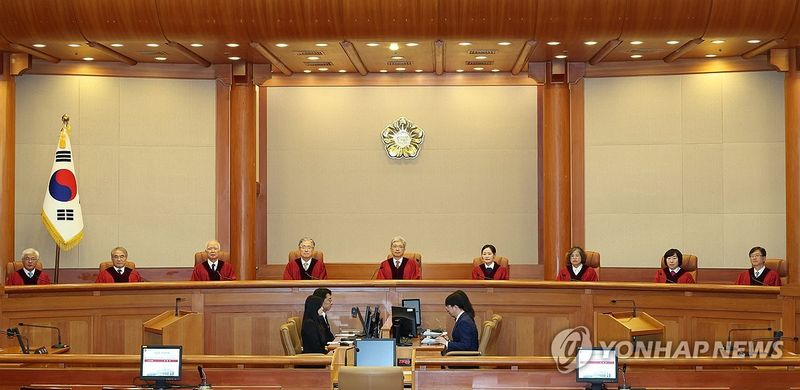
The Constitutional Court of Korea held a public hearing at 3 p.m. on the 21st in its Grand Courtroom in Jongno District, Seoul, in a case brought by Kim Young-su, a lawyer at Daeryun Law Firm, seeking to have a Supreme Court decision overturned. It was the first public hearing held seven months after the revised Constitutional Court Act took effect last March. Before the revision, the Constitutional Court Act excluded “court judgments” from the scope of constitutional complaints. The revised law allows parties to file a constitutional complaint when a final court ruling violates the Constitution or a law, or runs counter to the principles of due process, among other grounds.
The case stemmed from the investigation into the 2022 death of the late Sgt. Lee Ye-ram. The special counsel team led by Ahn Mi-young searched the residence and offices of lawyer Kim, who was then a witness, and seized items including a mobile phone and a tablet PC. Kim asked for a copy of the search warrant, but the special counsel team refused.
Kim filed a quasi-appeal seeking to overturn the search and seizure and the decision to refuse to provide a copy of the warrant. In May 2023, the Seoul Central District Court ruled that the search and seizure were unlawful and overturned them, but rejected the challenge to the refusal to provide a warrant copy, saying there was no obligation to provide one to a third party who was not a suspect. Both sides filed further appeals, but the Supreme Court dismissed them all in February this year. Two months later, in April, Kim filed a constitutional complaint against the final court judgment, arguing that the Supreme Court decision violated his right to equality and his freedom of privacy.
Article 118 of the Criminal Procedure Act stipulates that a copy of a warrant must be provided when the person subject to a search and seizure warrant is a defendant, while Article 219 of the same act applies this provision to searches and seizures by investigative agencies. The question, then, is whether it constitutes reasonable discrimination to impose different obligations to provide a copy depending on whether the person subjected to the search is a suspect.
The petitioner’s side argued that refusing to provide a copy of the warrant solely because the person is not a suspect violates the principles of due process and discriminates against the person subjected to the search without reasonable grounds. The Justice Ministry, an interested government agency, took the position that suspects and non-suspects are fundamentally different when it comes to ensuring the right to a defense. It argued that providing non-suspects with a copy of the warrant could reveal the investigation and compromise its secrecy.
In a written opinion, the Korean Bar Association countered that the need to keep an investigation secret diminishes substantially once execution of the warrant begins and the warrant is presented. It said that, given the limits of human memory, simply presenting the warrant is not enough to protect the rights of non-suspects.
Choi Ho-jin, a professor in Dankook University’s Department of Law who was designated by the Constitutional Court as a witness on its own initiative, cited the rationale behind the provision requiring warrant copies to be given to suspects, who have the greatest motive to destroy evidence. He said the effectiveness of an investigation alone cannot be decisive grounds for refusing to provide a copy to non-suspects.
Based on the hearing and statements from interested parties and witnesses, the Constitutional Court plans to determine both whether the Supreme Court decision violated lawyer Kim’s fundamental rights and whether the relevant provision of the Criminal Procedure Act is unconstitutional. The court will also hold a public hearing on the 23rd in a case seeking to overturn a ruling related to a surcharge against Green Cross over collusion in a vaccine bidding process. According to the Herald Business, this is the first case to be referred to a full bench since the introduction of the system of constitutional complaints against final court judgments.
[email protected] Kim Dong-gyu Reporter