Gulf crude oil exports recover to pre-Iran war levels
- Input
- 2026-10-21 11:33:54
- Updated
- 2026-10-21 11:33:54
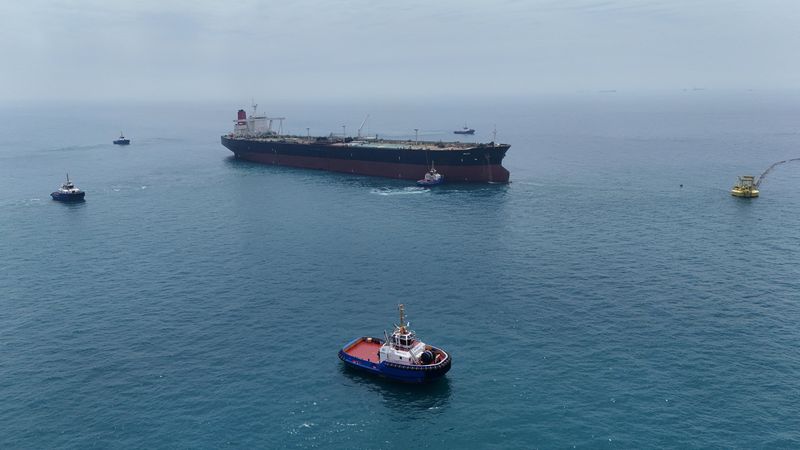
[Financial News] With a temporary maritime transport system established under U.S. protection now operating, crude oil exports from the Persian Gulf region have surpassed prewar levels despite Iran's intense attacks.
On the 20th (local time), The Wall Street Journal (WSJ) reported that, according to data from ship-tracking firm Kpler, average daily crude oil outflows from the Middle East—including shipments through the Strait of Hormuz and via alternative routes—reached 24 million barrels during the week ending on the 18th, exceeding the prewar level of 23 million barrels. Volumes passing directly through the Strait of Hormuz or transferred between ships in waters near the Gulf of Oman also recovered to about 14 million barrels a day, or 82% of the prewar level.
Iran's Islamic Revolutionary Guard Corps (IRGC) continues guerrilla-style attacks using drones, missiles and small fishing boats, but appears unable to cut off the transport network. The share of shipments diverted through Saudi Arabia's and the United Arab Emirates' (UAE) transcontinental pipelines rose from 17% before the war to 40% last September.
In addition, U.S. air support is being provided along a maritime corridor established off the coast of Oman. Tankers load crude in the Persian Gulf, switch off their automatic identification systems (AIS) and pass through the danger zone. They then transfer their cargo to larger vessels in relatively safer waters near Oman before reentering the Persian Gulf, using a “shuttle” operation.
Hamad Hussein, chief commodities economist at Capital Economics, said, “A transport system for navigating the dangerous Strait of Hormuz is now established, and those involved in crude exports have also become more willing to take risks,” adding, “Iran would have to act far more aggressively to exert the same degree of control it had in the past.”
The biggest driver keeping crude oil shipments going is “enormous profits.” Kpler analyst Omayoun Palakshahi explained, “Reselling Iraqi crude can bring an additional $20 per barrel, generating about $40 million (about 55 billion won) per voyage by a very large crude carrier (VLCC,” and added, “After just three successful voyages like these, you can recoup about $100 million—the price of a used tanker.”
Seafarers sailing through dangerous areas are also paid risk allowances equal to two to three times their regular monthly salary. A Chinese crew-recruitment firm has offered up to $25,000 (about 34 million won) for a round trip lasting roughly one to two weeks. As a result, even aging vessels that used to carry Venezuelan or Russian crude are being redeployed to Middle Eastern routes.
Crude oil flows have been maintained, but market anxiety and cost pressures are mounting. Brent crude, the international oil-price benchmark, has recently surged to around $108 a barrel.
About 30 vessel attack incidents have been reported in October alone, and real damage has also occurred, including a rocket-propelled grenade (RPG) attack on a Tanzania-flagged tanker that left a hole in its water tank.
As a result, freight rates for large tankers traveling from the Middle East to China have reached $37.37 per barrel, nearing an all-time high, while war-risk insurance premiums have surged from less than 3% to as much as 10% of a vessel's value.
Natasha Kaneva, JPMorgan's global head of commodities strategy, said, “If the problem in April was a ‘shortage of crude oil,’ the problem in October is the ‘cost of moving crude oil.’” Traders warn that the transport network could be paralyzed again if Iran, whose position has weakened ahead of the U.S. midterm elections, launches even stronger provocations.
[email protected] Yoon Jae-jun Reporter