550 Trillion Won in AI Investment: Who Will See Earnings Gains First? ‘Benefit Timeline’ for Construction and Power Stocks in Focus
- Input
- 2026-10-21 11:19:57
- Updated
- 2026-10-21 11:19:57
[Financial News] A domestic AI data center investment plan worth 550 trillion won is drawing attention as a new growth driver for construction and power stocks. There are hopes that the benefits could spread beyond semiconductors to companies that build data centers and supply electricity. Investors’ focus, too, appears to be shifting from the scale of the investment plan to when it will generate actual contracts and earnings.
As of 11 a.m. on the 21st, GS Engineering & Construction was trading at 29,350 won, up 3.89% from the previous trading day. Xi S&D rose 3.21% to 8,360 won, while SK eternix Co., Ltd. and SGC Energy Co., Ltd. gained 2.23% and 2.09%, respectively.
The investment appeal of companies involved in AI data centers depends on how quickly they can turn large-scale investment plans into contracts and earnings. That is also why construction is considered a sector set to benefit first. If data center construction gets underway in earnest, it could contribute to earnings from 2027, with a potentially substantial improvement relative to companies’ existing earnings.
The government announced last June an AI data center investment plan worth 550 trillion won, targeting 8.4 GW of capacity by 2029. Under the plan, SK Telecom, GS Group and Naver will pursue facility construction, while the government will support the securing of power and sites as well as permitting. As the investment plan moves into implementation, work could also increase in related industries such as construction and power supply.
Short construction periods are an advantage for construction companies. Building an AI data center costs 9 billion to 12 billion won per megawatt of power capacity. Construction takes about two years, shorter than the average three to four years for housing and plant projects. Large-scale projects can be completed relatively quickly, so revenue is recognized sooner after contracts are won. The shorter timeline also helps reduce the cost burden associated with extended construction periods.
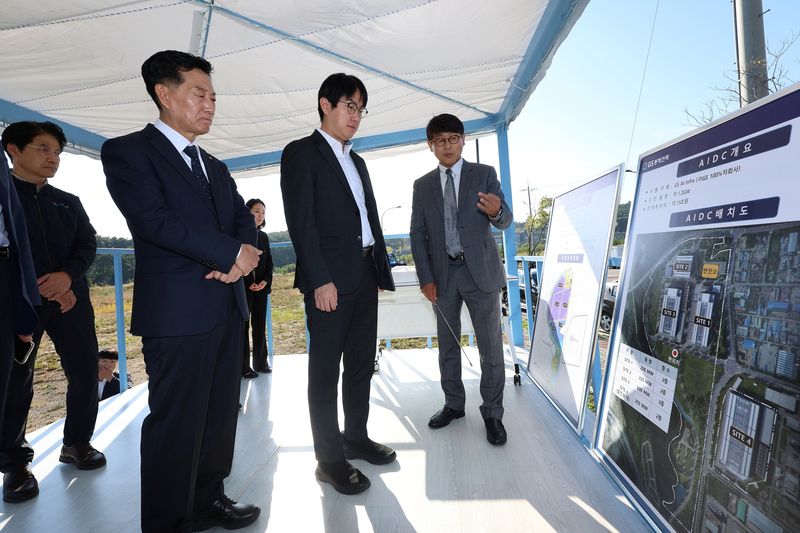
GS Group’s Donghae data center is a key project for gauging whether investment plans will translate into actual work. GS Group plans to complete facilities with a capacity of 1.2 GW in phases starting in 2028, and then expand the total capacity to 2.4 GW. Since the group can draw on its capabilities in power generation, construction and operations, the benefits for related affiliates are expected to become more tangible as the project progresses.
Companies in the power sector have different ways of generating revenue. For SGC Energy Co., Ltd., the key question is whether it can recover its investment and secure profits through data center development projects. For SK eternix Co., Ltd., the focus is on whether it can secure data centers as customers under long-term power purchase agreements (PPAs).
However, not all announced investment plans will be realized in the short term. The report identified about 1.5 GW of the total 8.4 GW as the volume most likely to move forward first, given that the power supply arrangements have been fleshed out. The remaining projects will require grid expansion, financing and the securing of customers who will use the facilities over the long term.
Kim Sun-mi, an analyst at Shinhan Securities, said, “Data centers are a key market that will boost construction companies’ earnings outlook in the short term. For construction companies, the biggest advantage of data centers is that construction costs are high and construction periods are short.” He went on to forecast, “Considering the time it takes for construction work to ramp up in earnest and begin generating revenue, the amount of revenue recognized annually, and the business risks that could arise during construction, data centers will contribute far more to short-term earnings.”
[email protected] Choi Doo-sun Reporter