LG Chem to use AI to boost precision in drug development... and for patient selection
- Input
- 2026-10-21 11:02:27
- Updated
- 2026-10-21 11:02:27
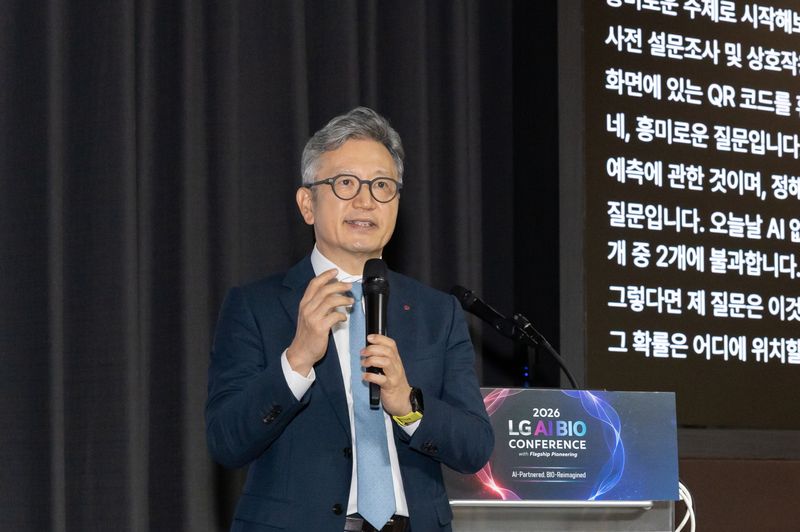
LG Chem said on the 21st that it had held the 2026 LG AI Bio Conference on the 20th at the ISC building at LG Sciencepark in Gangseo-gu, Seoul, together with LG AI Research and U.S. biotech venture capital firm Flagship Pioneering.
The event was held for the first time to foster an innovative AI biotech ecosystem in Korea and expand global collaboration. Around 140 representatives of AI biotech companies from Korea and abroad attended and discussed the future direction of AI-driven drug development and ways to spur innovation in the industry.
LG Chem plans to focus in particular on innovating clinical development with AI in the field of precision oncology. Taking into account the complex biological characteristics of tumors, the company plans to use biomarkers to select patients suited to clinical trials and to apply AI in developing treatment strategies. Biomarkers are biological indicators used to assess disease status, response to treatment and other factors.
In his opening remarks, Son Ji-woong, head of LG Chem’s Life Sciences Business Division, said, “AI is not a tool for drug development but is evolving into a core engine that determines competitiveness. The competitiveness of future drug development lies not only in finding structurally superior drugs, but also in using AI to identify patients who are likely to benefit most from treatment.”
Personalized mRNA cancer vaccines are also a key development priority. LG Chem is building and refining an AI model to predict patient-specific neoantigens that induce an immune response against cancer cells. The strategy is to improve the precision of cancer treatment by identifying suitable treatment targets for each patient.
The conference also featured examples of AI-driven drug development by global companies. Andre Andonian, Asia-Pacific chair at Flagship Pioneering, said the company was expanding collaboration in the life sciences based on AI. Citing examples including Moderna and Lyell Sciences, he explained that AI was becoming a key driver of corporate growth.
Ju Wang, head of global business development at Insilico Medicine, presented a case in which a drug candidate identified using generative AI had entered the clinical stage. Ryan Leung, head of life sciences products at Lyell Sciences, introduced the concept of an autonomous laboratory where AI agents repeatedly carry out design, synthesis, experimentation and learning.
The panel discussion covered patient cohort selection using cancer whole-genome data, as well as strategies for biomarker discovery and patient selection using AI technologies based on spatial biology. LG Chem plans to use the event as an opportunity to strengthen collaboration with global AI biotech companies and expand its AI-driven drug development capabilities.
[email protected] Jung Sang-hee Reporter