74% of essay-focused early-admission applicants also prepare for regular admissions; 67% of school-record subject-track applicants are less active
- Input
- 2026-10-21 10:47:40
- Updated
- 2026-10-21 10:47:40
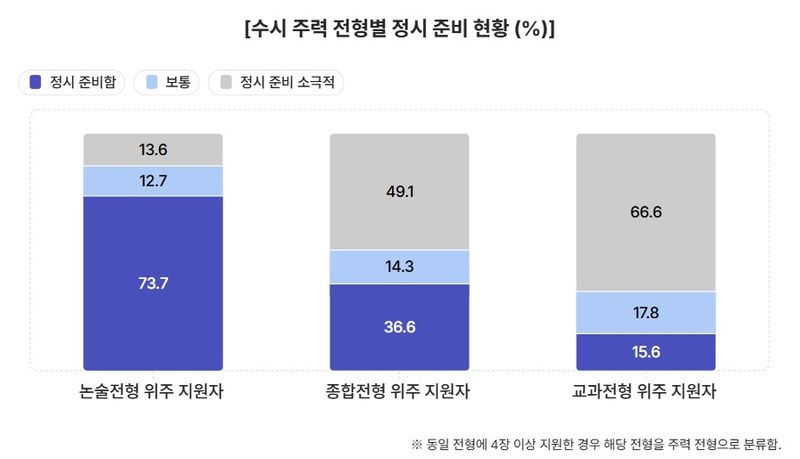
[Financial News] With less than a month to go before the 2027 College Scholastic Ability Test (CSAT), early-admission applicants’ attitudes toward preparing for regular admissions were found to vary widely depending on their main admissions track. While 73.7% of applicants focusing on the essay-based track said they were also preparing for regular admissions, 66.6% of those focusing on the school-record subject track were less active in their preparation.
Jinhaksa announced on the 21st that this was the finding of an online survey of 3,706 applicants to the 2027 early-admissions cycle. The survey classified a track as an applicant’s “main admissions track” if they had applied to it at least four times.
Looking at all applicants, more than half were less active in preparing for regular admissions. A total of 2,021 respondents, or 54.5%, said they were either not really preparing for regular admissions or not preparing at all. Of these, 1,239 (33.4%) said, “I’m not preparing at all,” and 782 (21.1%) said, “I’m not really preparing.” Meanwhile, 30.2% said they were preparing for regular admissions: 17.8% said, “I’m somewhat preparing,” and 12.5% said, “I’m preparing actively.”
Woo Yeon-cheol, head of Jinhaksa’s Admissions Strategy Research Institute, said, “More noteworthy than the figure showing that more than half of early-admission applicants are less active in preparing for regular admissions is the fact that their attitudes toward preparation differed greatly depending on the admissions track they applied to.” He added, “Applicants focusing on the school-record subject track appear to have prioritized gaining admission through early admissions using their school grades, whereas those focusing on the essay-based track seem to have adopted a strategy that took both early and regular admissions into consideration.”
Jinhaksa explained that applicants focusing on the essay-based track may have sought to apply to more selective schools through early admissions, while also considering the possibility of applying through regular admissions on the strength of their CSAT competitiveness. It added, however, that being less active in preparing for regular admissions does not mean they are not studying for the CSAT. Some may be studying to meet the “minimum CSAT score requirement” set by the universities they applied to through early admissions—that is, the minimum CSAT score required for acceptance.
Woo said, “Rather than interpreting responses that applicants are less active in preparing for regular admissions simply as giving up on the CSAT, we should see them as the result of applicants setting different priorities for early and regular admissions according to their own competitiveness and the characteristics of the admissions tracks they applied to.”
[email protected] Kim Man-gi Reporter