Mega Special Zone’s 52-hour workweek exemptions draw opposition from labor groups and Cho Kuk; ruling party pivots to bill without exemptions
- Input
- 2026-10-21 10:39:35
- Updated
- 2026-10-21 10:39:35
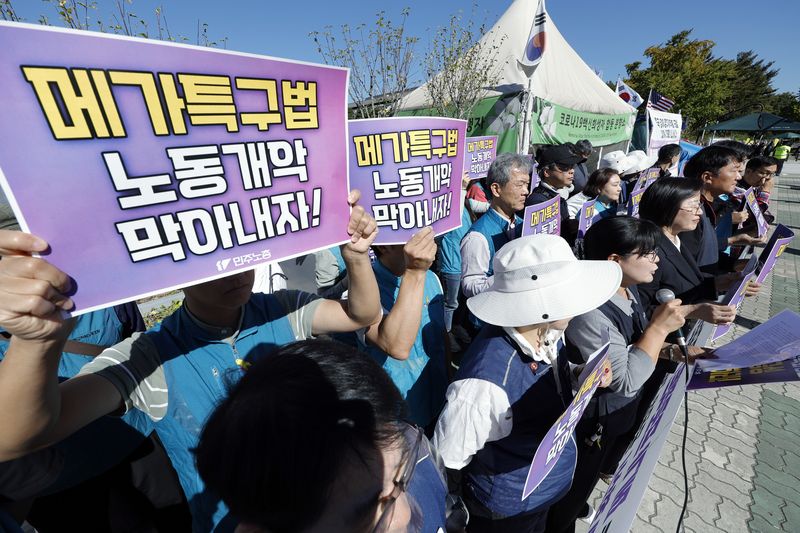
On the 21st, Cho posted on his social media account that “the Democratic Party must uphold tax justice and the 52-hour workweek” and called for the withdrawal of working-hours exemptions in super-regional special zones. He supports establishing a semiconductor cluster in Honam but says labor-hour regulations should not be relaxed under that pretext. He pointed out in particular that the ruling party’s push for working-hours exemptions runs counter to the purpose of social dialogue, given that the KCTU returned to tripartite dialogue after six years at President Lee Jae-myung’s request. The Rebuilding Korea Party also issued a statement criticizing the Democratic Party’s parallel pursuit of two bills that differ on whether to include labor exemptions as “testing the waters of public opinion,” and called for the exemptions to be removed.
The controversy erupted when Rep. Park introduced a super-regional special zone bill the previous day that included an exception to the 52-hour workweek for R&D personnel in the top 3% by earned income. It also included provisions extending the settlement period for the flexible working-hours system from three months to six months, and the period for employing fixed-term workers from two years to a maximum of four years.
The KCTU immediately issued a statement, saying that “substantive discussion of the key issues has not even begun in the one-point social dialogue on Mega Special Zones,” and condemning the bill’s introduction and calling for its withdrawal. The Korean Federation of Trade Unions also criticized the push to legislate labor exemptions before consultations with labor groups had concluded, calling it “a double standard.” The Progressive Party likewise opposed the bill, citing concerns about violations of labor rights.
As opposition intensified, the Democratic Party prepared a separate super-regional special zone bill with most labor exemptions removed, through Rep. Choi Ki-sang, the ruling party’s secretary on the National Assembly’s Climate, Energy, Environment and Labor Committee. The bill Choi is set to introduce on the 21st removes the exception to the 52-hour workweek, the extension of the settlement period for the flexible working-hours system, and the extension of the period for employing fixed-term workers. It also excludes exemptions related to the establishment of foreign medical institutions and pharmacies exclusively for foreign nationals, as well as foreign schools. Instead, it retains the basic framework for fostering industry, including designating strategic industrial special zones across super-regions and providing fiscal, financial, and tax support. However, some labor-related exemptions remain, including allowing unpaid holidays at foreign-invested companies and expanding dispatched work.
Democratic Party spokesperson Jo Gye-won told reporters after the Supreme Council meeting that “there will of course be a process of coordination with labor groups on the 52-hour workweek. The reason we submitted both bills is that public discussion is needed to that extent,” adding, “We are not going to push this through unilaterally without further consideration; we will leave it fully open and deliberate.”
[email protected] Song Ji-won Reporter