“Ministry of Science and ICT, KMCC see complaint buck-passing surge 12-fold year on year”
- Input
- 2026-10-21 10:23:00
- Updated
- 2026-10-21 10:23:00

Complaint transferred 16 times... 40 days to resolve
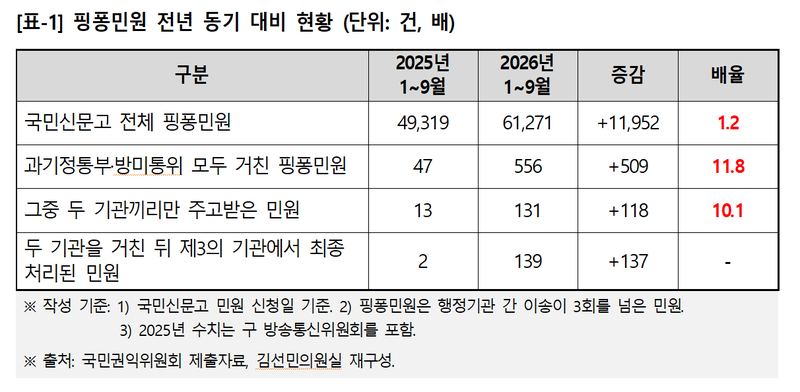
According to data obtained from the Anti-Corruption and Civil Rights Commission by Rep. Kim Seon-min of the Rebuilding Korea Party, a member of the National Assembly’s Science, ICT, Broadcasting and Communications Committee, on the 21st, 556 cases were recorded among complaints transferred more than three times between administrative agencies from January to September this year that had passed through both the Ministry of Science and ICT and KMCC.That was an 11.8-fold surge from 47 cases during the same period last year.
Over the same period, the total number of ping-pong complaints filed through e-People rose just 1.2-fold, from 49,319 to 61,271.
Rep. Kim pointed out that cases in which the two agencies alone passed complaints back and forth more than three times also rose about tenfold, from 13 to 131. Complaints that passed through the Ministry of Science and ICT and KMCC before being ultimately handled by a third agency, such as the Korea Consumer Agency or the National Police Agency, increased from 2 to 139.
There was also a case that took 40 days to resolve because of repeated transfers. A complaint filed on October 30 last year over harm caused by unauthorized enrollment in a telecom carrier’s paid add-on service was transferred between KMCC and the Ministry of Science and ICT seven and six times, respectively. It was resolved only after moving between agencies a total of 16 times.
Complaints related to an incident in which a failure of storage equipment at an aging data center permanently erased data belonging to 292 client companies also went back and forth between the two agencies. In response to a complaint requesting an investigation into the state of user-protection measures, KMCC determined that the matter fell under the Ministry of Science and ICT’s jurisdiction under the Cloud Computing Act. The ministry replied that, under the Telecommunications Business Act, the authority to conduct fact-finding investigations and order corrective measures rested with KMCC. A complaint filed on September 5 was transferred between the two agencies seven times from the 7th to the 11th, after which the agency responsible for handling it was determined through mediation by the Anti-Corruption and Civil Rights Commission.
No clear complaint-handling criteria even after reorganization
A government reorganization last October transferred some broadcasting functions handled by the Ministry of Science and ICT to KMCC, but telecommunications functions were not transferred. Even so, confusion between the agencies over handling complaints related to telecom rates, paid add-on services and device sales continued. The number of ping-pong complaints that passed through both agencies had already reached 481 from November 2025 through May this year.The two agencies launched a policy consultative council in June this year, about eight months after the reorganization, and held their first working-level meeting last September. However, the two meetings covered topics including artificial intelligence (AI), over-the-top (OTT) services and digital regulation, while criteria for handling repeatedly transferred complaints were not included on the agenda, according to the data.
Ping-pong complaints have fallen to the 30s per month since August this year, but that is still six to seven times the pre-reorganization monthly average of around five.
Rep. Kim said, “Some broadcasting functions were transferred, but even telecommunications complaints are being bounced between the two agencies,” adding, “I deeply regret that they are passing considerable inconvenience on to the public, each saying the matter is not their responsibility.” She continued, “The two agencies should analyze why ping-pong complaints have increased and clearly establish criteria for which agency is responsible for handling them,” and said, “They should set up a system to jointly handle complaints when it is unclear which agency is responsible.”
Ping-pong complaints are complaints that administrative agencies transfer to other agencies, each claiming the matter does not fall under its jurisdiction. In this data, ping-pong complaints were counted as e-People complaints transferred more than three times between administrative agencies.
[email protected] Yoon Hong-jip Reporter