After Watching Unrest in France, Poland and Hungary Shut the Door Even Tighter on Immigration
- Input
- 2026-10-21 10:12:14
- Updated
- 2026-10-21 10:12:14
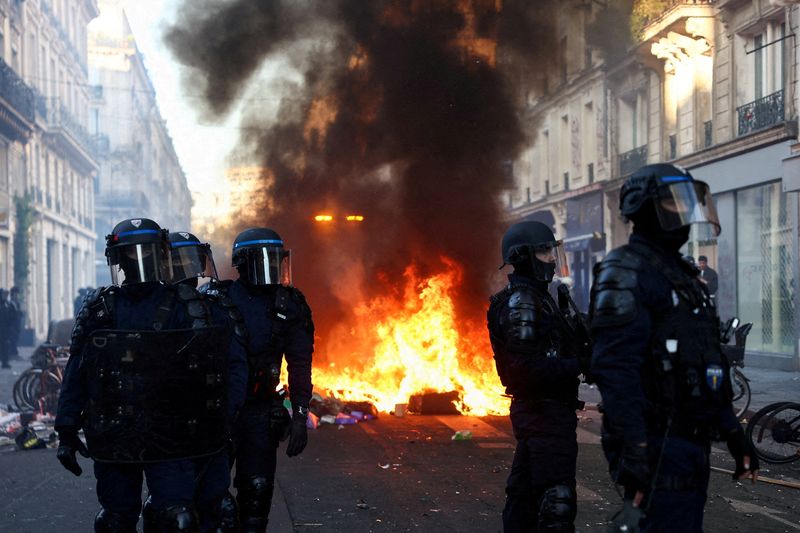
[Financial News] As videos of burned-out cars and damaged historic buildings in major French and Italian cities spread across Europe, Eastern European leaders, including those of Hungary and Poland, have seized on them to further justify strong anti-immigration policies.
On the 20th (local time), Fox News Channel reported that Hungary and Poland were strengthening their anti-immigration policies with the aim of tightening domestic border controls and immigration restrictions further, taking the security problems and riots in Western Europe as a cautionary example.
Hungarian Prime Minister Péter Magyar recently said on X (formerly Twitter), “Seeing the indiscriminate destruction and unjustifiable violence, it must have become clear to everyone why Hungary adheres to such strict immigration policies,” adding, “We will not ease our border protection or immigration control policies under any pressure.”
Polish Prime Minister Donald Tusk also reiterated his hard-line stance, saying, “Poland will neither repeat the mistakes of other European countries nor pay the price for them,” and, “We will rigorously defend our borders against illegal immigration, accept no asylum applications, and deport without hesitation anyone who breaks the law.”
Swedish political scientist Daniel Schatz said, “Videos of arson and looting in France and elsewhere are becoming powerful political weapons across Europe,” adding, “A single video of chaotic scenes has far greater political impact on the public than a hundred policy speeches.”
According to 2025 data from Eurostat, the European Union’s statistical office, France has about 10 million foreign-born residents and Italy about 7 million. Poland’s figure is about 1 million, roughly half from Ukraine, while Hungary’s is 700,000, most from other EU countries.
The countries also differ considerably in crime statistics. In 2024, the number of crimes reported to police was 304,900 in France and 142,600 in Italy, compared with 57,300 in Poland and 28,600 in Hungary, markedly lower figures for the Eastern European countries. As of 2023, the share of people who perceived crime or property damage in their area was much higher in France, at about 20%, and Italy, at 14–17%, than in Poland (7–8%) and Hungary (6–7%).
Professor Boštjan Udovič of the University of Ljubljana in Slovenia said, “In Central and Eastern European countries, the unrest in France is seen as directly linked to immigrants’ failure to adapt and the lack of social integration,” adding, “It is practically difficult to ask Eastern European countries, which achieved independence on the basis of a single-ethnic national identity, to embrace the concept of a multicultural society.”
Experts interpret the two leaders’ actions as both a message to the European Commission (EC) and a strategy to consolidate their domestic political standing. Hungary and Poland have previously opposed the EU’s refugee relocation policy and have also been fined and sanctioned by courts.
In Poland, with the 2027 general election approaching, even former Prime Minister Mateusz Morawiecki of the opposition’s right-wing alliance has said, “France is on fire” and “We, too, must wise up before we suffer the consequences.” Immigration is expected to be a key issue in the upcoming election.
Analysts say Hungarian Prime Minister Magyar is also actively using immigration as an issue that can divert attention from domestic political challenges and win broad public support, while maintaining the strict border-control policies that have continued since former Prime Minister Viktor Orbán’s time in office.
Magyar stressed, “Peaceful and lawful protests are clearly different from acts of destruction and violence,” adding, “With the Europe we love facing a serious crisis, it is our responsibility to protect the safety of the continent for the next generation.”
[email protected] Yoon Jae-jun Reporter