“Is losing weight always a good thing?” ... Underweight linked to a 57% higher risk of death in older adults [Health Check]
- Input
- 2026-10-21 08:34:57
- Updated
- 2026-10-21 08:34:57
[Financial News] Among adults aged 55 and older, the risk of death was found to be much higher when they were underweight than when they were obese, while the risks of cardiovascular disease and atrial fibrillation were more closely associated with fat accumulated around the abdomen than with body weight.
A research team led by Professor Kang Si-hyeok of the Department of Cardiology at Seoul National University Bundang Hospital, with resident Jeon Se-jun as first author and senior researcher Kim Seon-hwa, analyzed about 1.2 million adults aged 55 and older and found that the obesity measure most closely associated with risk varied by disease.
Obesity is associated with a range of conditions, including cardiovascular disease, cancer and atrial fibrillation, as well as the risk of death. Body Mass Index (BMI), calculated by dividing weight by height squared, has been the most widely used measure for assessing obesity. In Asia, including South Korea, a BMI of 25 kg/m2 or higher is classified as obesity.
However, BMI reflects only total body weight and does not show where fat is accumulated. It has long been criticized for failing to adequately reflect visceral fat, a key risk factor for cardiovascular and metabolic diseases. Waist circumference, which indicates the degree of abdominal obesity, and the Body Roundness Index (BRI), first proposed in 2013, have therefore been suggested as alternative measures. BRI uses height and waist circumference to estimate how round the body is and the proportion of visceral fat.
However, most previous studies focused on just one disease, and few directly compared multiple measures across a range of diseases.
Using data from the National Health Insurance Service, the research team followed participants for up to 10 years and analyzed how three obesity measures were associated with atherosclerotic cardiovascular disease (myocardial infarction, ischemic stroke and death from cardiac causes), all-cause mortality and atrial fibrillation.
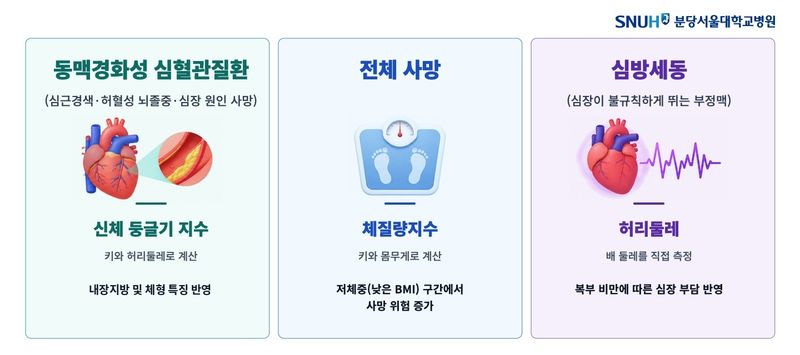
Overall mortality was most closely associated with BMI. In particular, the risk of death was much higher among those who were underweight than among those with obesity. When participants were divided into five groups by BMI, the group with the lowest values had an approximately 57% higher risk of death than the middle group, even after other risk factors were adjusted for. The research team interpreted this as reflecting not only body weight, which BMI measures, but also age-related frailty or unintentional weight loss.
To rule out the effect of weight loss caused by pre-existing conditions, the research team reanalyzed the data after excluding people who died or developed a major disease within the first 1–2 years of follow-up. The trend remained largely unchanged.
Atherosclerotic cardiovascular disease was most strongly associated with BRI. The risk increased with higher BRI values even after adjustment for age, sex, diabetes, hypertension, dyslipidemia, smoking and comorbidities. The research team concluded that this measure, which combines height and waist circumference, better reflects the accumulation of visceral fat associated with cardiovascular disease.
Atrial fibrillation showed the clearest association with waist circumference, and the results remained the same after adjustment for other risk factors. The research team considered waist circumference—which directly indicates fat accumulated around the abdomen—to be the best reflection of risk, given atrial fibrillation’s close association with abdominal obesity.
However, all three measures had limitations in identifying disease risk based on a single value alone. Even so, the study is significant in showing that, rather than relying on a single obesity measure as in the past, different measures should be considered according to the diseases of concern.
Professor Kang Si-hyeok said, “Whereas in the past we simply advised people to ‘lose weight,’ patients concerned about cardiovascular diseases such as myocardial infarction, stroke and atrial fibrillation now need personalized care that considers waist circumference as well as body weight.” He emphasized, “For older adults in particular, it is important to adopt healthy lifestyle habits aimed at maintaining muscle mass and reducing abdominal obesity rather than pursuing excessive weight loss.”
The findings were published in the international journal PLOS One.
[email protected] Jeong Myeong-jin, Medical Correspondent Reporter