“Defense stocks: Why the sudden plunge?” ... A closer look at concerns over delayed orders and U.S. defense spending
- Input
- 2026-10-21 07:39:20
- Updated
- 2026-10-21 07:39:20
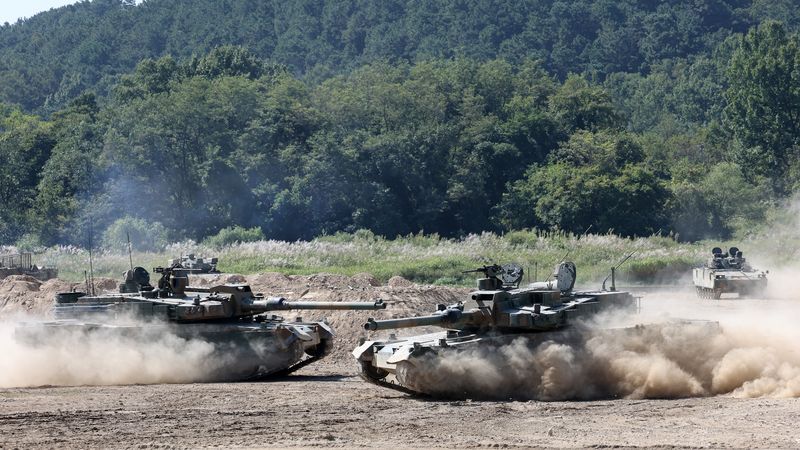
[Financial News] Domestic defense stocks plunged amid concerns over delayed orders and cuts to U.S. defense spending, but analysts say the declines have been excessive. With demand for weapons among major export markets and order opportunities next year still strong, it is too early to worry about a slowdown in growth, they say.
On the 21st, Daishin Securities said shares of Hyundai Rotem and Hanwha Systems fell 15.3% and 15.1%, respectively, the previous day. Hanwha Aerospace dropped 12.5%, LIG D&A fell 9.2%, and Korea Aerospace Industries declined 7.3%. While global defense companies’ shares remained resilient, the declines were concentrated in major domestic defense stocks.
Delayed orders and concerns over cuts to U.S. defense spending have been cited as reasons for the declines. After Hyundai Rotem released its third-quarter results this year, concerns grew that new contracts for domestic defense companies could be delayed. The prospect of defense spending falling after the U.S. midterm elections in November also weighed on the stocks, according to analysts.
Securities industry officials believe, however, that changes in U.S. defense spending will have only a limited short-term impact on the earnings of domestic defense companies. The share of U.S. business in these companies’ total revenue is still small, and U.S. self-propelled howitzer and propellant-charge programs have proceeded regardless of changes in administration, they say.
Countries’ efforts to build self-reliant defense industries are also seen as an export opportunity. As more countries seek to produce weapons at home and secure their supply chains, domestic companies pursuing local production and technology cooperation may continue to find business opportunities.
Major order prospects for next year also remain. For Hanwha Aerospace, potential drivers include a project for Saudi Arabia’s Ministry of National Guard (MNG) and a U.S. mass-production program for wheeled and tracked self-propelled howitzers. LIG D&A’s joint venture with Rheinmetall and Hanwha Systems’ multifunction radars for medium- and long-range surface-to-air guided weapons, as well as exports of Cheongwang, are also being discussed.
Choi Jeong-hwan, a researcher at Daishin Securities, said, “Countries’ efforts to build self-reliant defense industries are a structural change,” adding, “The progress companies make in their business development activities to meet that demand for self-reliance will create valuation gaps among them.”
Korea Aerospace Industries was named as a company expected to make the first export of the KAI KF-21 Boramae in the fourth quarter of this year. Several countries, including the Philippines and the United Arab Emirates (UAE), have shown interest, the report said. Hyundai Rotem’s K2 tank acquisition project in Peru next year and the possibility of resuming business development efforts in Romania and Iraq were cited as developments to watch.
Choi stressed, “We believe there is no basis for a discount relative to global peers, given the active localization strategies recently pursued by domestic defense companies.”
[email protected] Choi Doo-sun Reporter