“Can’t you see the plunge?” ... “Samsung Electronics at ₩670,000, SK hynix at ₩4.7 million”: Nomura stands by its bold forecast—what’s the basis?
- Input
- 2026-10-21 07:10:11
- Updated
- 2026-10-21 07:10:11
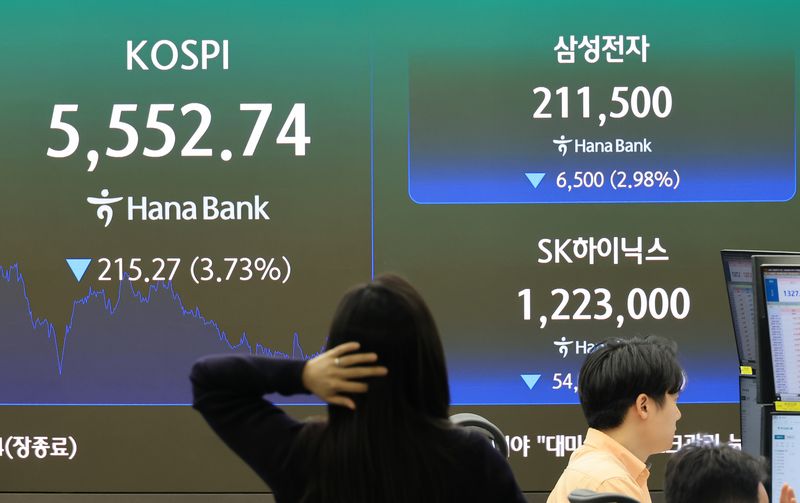
[Financial News] Global investment bank Nomura kept its target prices for Samsung Electronics and SK hynix unchanged at 670,000 won and 4.7 million won, respectively, on the outlook that the memory supply shortage will continue through 2028.
Target prices for the two biggest chipmakers maintained despite China-driven “AI headwinds”
According to securities industry sources on the 20th, Nomura maintained its positive outlook for the market in its global memory report published on the 19th, “AI Market Concerns and the Memory Outlook,” forecasting that bottlenecks in the memory supply chain would persist at least through 2028.
Nomura named Samsung Electronics and SK hynix as stocks to watch, assigned both companies a “Buy” rating and kept their target prices unchanged. Nomura’s target price is therefore 670,000 won for Samsung Electronics and 4.7 million won for SK hynix.
The market has recently been in a sharp downturn amid concerns that slowing revenue growth at AI companies such as OpenAI and financing pressures on data center operators could lead to a pullback in AI infrastructure investment. Advances in 4F2 technology by China’s CMXT are also seen as likely to intensify competition in the memory market, and are cited as a source of concern.
Analysis: Market concerns over CMXT’s transition to 4F2 technology are excessive
Nomura, however, assessed that these concerns do not sufficiently reflect the breadth of AI demand’s expansion or the industry’s overall ability to generate profits. It said, “The market is underestimating the profits that strong AI demand could generate across the value chain,” and also considered market concerns about CMXT’s transition to 4F2 technology excessive.
Nomura explained that although OpenAI and Anthropic had recently seen growth slow quarter over quarter, they would still post high growth rates compared with the same period a year earlier. It estimated that the two companies’ combined revenue rose by about 507% year over year in the third quarter of this year.
Nomura estimated that to reach the market’s expectation of about $100 billion in combined 2026 revenue for OpenAI and Anthropic, their fourth-quarter revenue would need to rise 61% from the previous quarter to about $43.9 billion. It forecast that even if the September revenue run rate were maintained, fourth-quarter revenue would be about $29.7 billion, up 291% from a year earlier.
Nomura also assessed that the likelihood of financing pressures on data center operators leading to an overall pullback in AI investment was limited. Even if an individual operator faced financial difficulties, other operators could acquire or use its GPUs and data center equipment, it said.
“Data center expansion” underpins the industry outlook ... “Chipmakers’ cash generation will grow”
The basis for the industry outlook is the pace of data center expansion. According to Nomura’s project-tracking data, global new data center capacity is expected to grow from 22.3 gigawatts (GW) this year to 31.5 GW next year. This year’s increase is 77% higher than last year’s, while next year’s projected new capacity is also 6% above Nomura’s previous model estimate of 29.7 GW.
Nomura explained, “Combining the data center construction outlook with assumptions about system configurations and memory capacity per system shows that memory demand growth will outpace supply growth at least through 2028.” It added, “This supports the outlook that constraints on memory supply will persist and that pricing conditions will remain favorable for memory producers.”
Nomura also forecast that semiconductor companies’ cash generation would grow. The combined net cash of nine semiconductor companies, including Samsung Electronics and SK hynix, rose from $27 billion in the first quarter of 2024 to $282 billion in the second quarter of this year, and is projected to reach about $2 trillion by the end of 2028.
[email protected] Kim Hee-sun Reporter