“Thought the market had hit bottom...” Retail investors who borrowed to invest hit by 340 billion won in forced liquidations over five days
- Input
- 2026-10-21 05:20:00
- Updated
- 2026-10-21 05:20:00
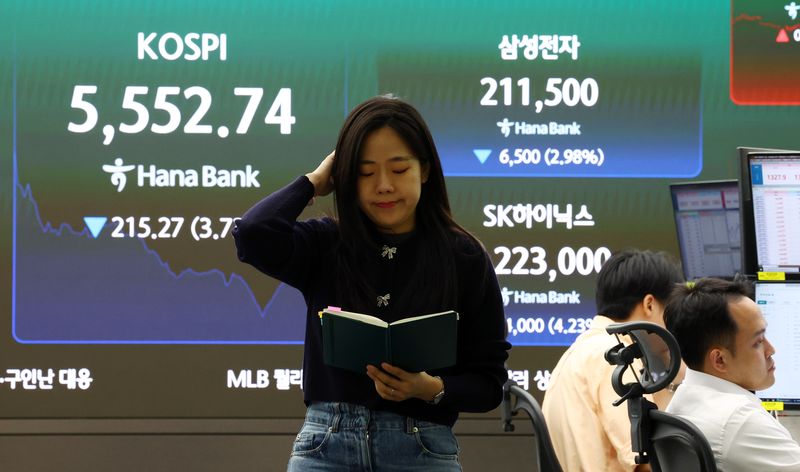
[Financial News] As the correction in South Korea’s stock market deepens, investor deposits—the funds waiting to buy stocks—have plunged to their lowest level in nine months. Forced liquidations of shares held by individual investors who borrowed to buy stocks have also exceeded 50 billion won for five consecutive trading days in the wake of the sharp drop in share prices, adding to downward pressure on the market.
According to the Korea Financial Investment Association, investor deposits stood at 92.0966 trillion won as of the 19th, down 2.3063 trillion won from the previous trading day. They have declined for five consecutive trading days since the 12th, when they stood at 100.4389 trillion won, with 8.3423 trillion won (8.31%) in funds waiting to enter the market flowing out during that period. This was the lowest level in about nine months, since Jan. 16, when deposits were 91.2181 trillion won.
Investor deposits are funds that investors keep in securities firm accounts to buy stocks or leave unwithdrawn after selling them, and are generally a key indicator of the capacity to enter the stock market. Their rapid decline shows that individual investors’ capacity to make additional purchases is shrinking sharply amid the bear market.
The Kospi index plunged 9.65%, from 6,384.24 on the 12th to 5,768.01 on the 19th. It then closed at 5,552.74 on the 20th, down 3.73% from the previous session, setting fresh year-to-date lows on successive days.
The sharp plunge in the index touched off the time bomb of “debt-fueled investing”—borrowing money to invest. As of the 19th, unpaid balances on brokerage trades had surged 34.40% to 1.4293 trillion won from 1.0635 trillion won a week earlier. This was the result of falling share prices eroding collateral values and a surge in accounts unable to meet settlement payments on time. The balance of credit transaction loans also fell by 1.1445 trillion won from the previous session to 31.1082 trillion won.
As unpaid balances mounted, forced liquidations—in which securities firms sell shares to recover the debt—also became a growing concern. The amount of forced liquidations related to unpaid brokerage-trading balances reached 54.2 billion won on the 19th alone. Following 59.3 billion won on the 13th, 89.3 billion won on the 14th and 80.5 billion won on the 15th, the amount exceeded 50 billion won for five consecutive trading days.
Forced liquidations over the five trading days from the 13th through the 19th totaled 340.7 billion won. That was about 4.4 times the 77.5 billion won recorded over the previous five trading days. The share of unpaid balances subject to forced liquidation also rose by 0.3 percentage points, from 4.1% to 4.4%.
Market experts warn that a vicious cycle of declines could take hold if dwindling funds waiting to enter the market coincide with a wave of forced-sale orders, in a market where individual investors are left to absorb selling by foreign investors and institutions alike. Forced selling triggered when investors cannot meet settlement payments could drive the index down further, creating new collateral shortfalls and setting off additional forced liquidations in a chain reaction.
[email protected] Mun Yeong-jin Reporter