Mainland Grid Connection for the Chuja Offshore Wind Project; Committee Chair Kim Jeong-ho Pledges National Assembly Support
- Input
- 2026-10-20 20:49:07
- Updated
- 2026-10-20 20:49:07
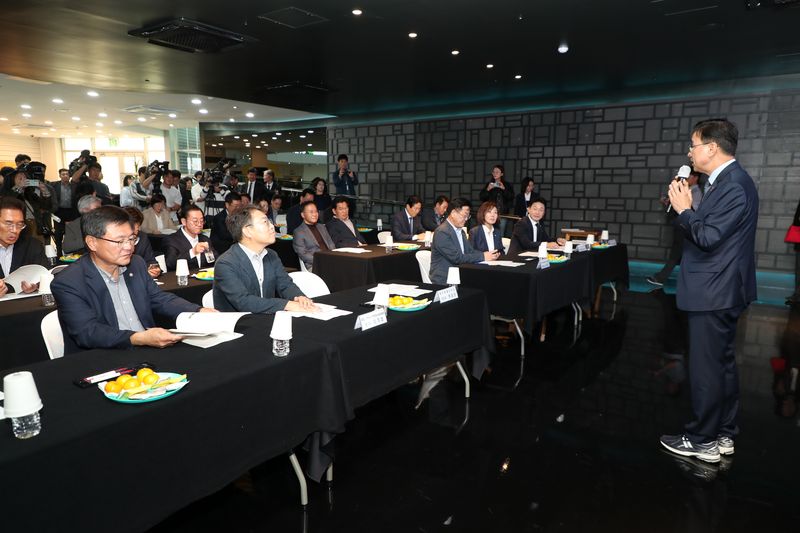
【Financial News, Jeju = Jeong Yong-bok, Staff Writer】 The National Assembly has signaled its willingness to provide budgetary and legislative support for Jeju’s energy transition issues, including connecting the Chuja offshore wind project to the mainland power grid. Jeju Special Self-Governing Province called for four institutional reforms, including waiving grid-use fees for energy storage systems (ESS) and easing the burden of industrial electricity rates.
According to Jeju Special Self-Governing Province on the 20th, Kim Jeong-ho, chair of the National Assembly Climate, Energy, Environment and Labor Committee, held an on-site meeting that day with Jeju Governor Wi Seong-gon at Energy Nuri Plaza in Haengwon-ri, Gujwa-eup, Jeju City, to discuss institutional reforms and financial support for the energy transition.
Chair Kim said, “We will carefully review the issues raised by Jeju and actively support them through budgets, policies and legislation at the National Assembly level.”
He specifically mentioned the possibility of connecting the Chuja offshore wind project to the mainland power grid. Chair Kim suggested that “connecting electricity generated by the Chuja offshore wind project to Sin Haenam Substation could create an opportunity to supply renewable energy to the semiconductor industry in the Honam region.”
He went on to stress that “Jeju needs to move quickly to reopen bidding for a project operator and carry out the related administrative procedures.”
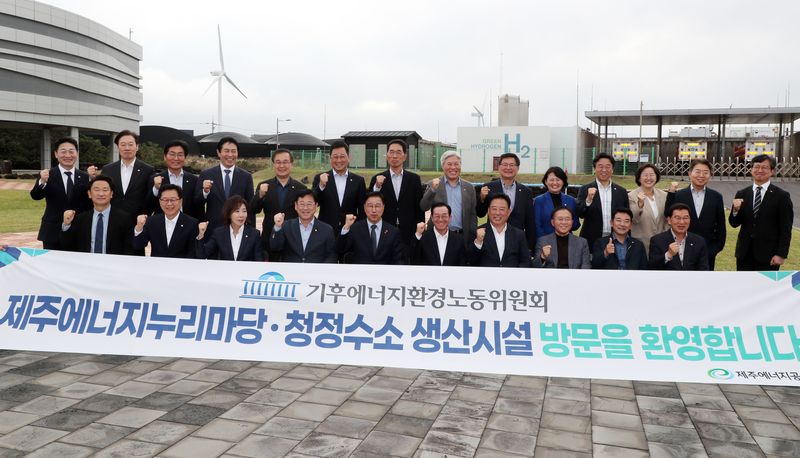
The Chuja offshore wind project is a large-scale renewable energy development project being pursued by Jeju, but selecting a project operator and securing a grid connection remain challenges.
A rebid for prospective project operators ultimately failed this past February, as no companies submitted the documents for the second-stage evaluation. A recent preliminary study by the Jeju Energy Corporation suggested that the planned generation capacity, initially considered at 2.37 GW, could be adjusted to about 1.79 GW. The final project size and grid connection method have not been determined.
Jeju Special Self-Governing Province used the National Assembly’s visit to call for the Chuja offshore wind project to be included in the 12th Basic Plan for Electricity Supply and Demand and connected to the national power system. The plan sets the government’s direction for developing power generation facilities and expanding the power grid over the medium to long term.
Jeju also requested a waiver of grid-use fees for ESS connected to the distribution grid. ESS facilities store electricity when renewable energy generation is high and supply it when needed. Jeju says institutional reform is needed to reduce the cost of using the power grid for energy storage facilities.
Jeju also called for easing the burden on the province arising from regional differences in industrial electricity rates and expanding financial support for the transition to electric vehicles.
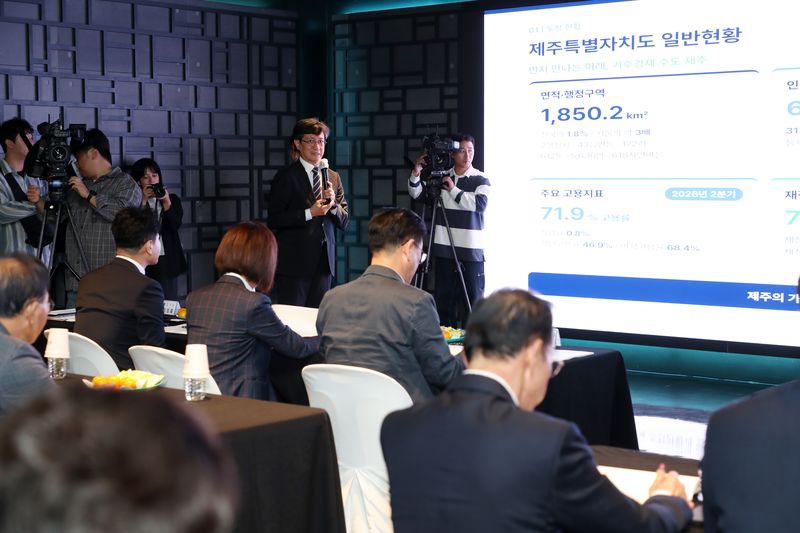
As of August this year, renewable energy facilities in Jeju had a capacity of 1,283.1 MW, accounting for 55.9% of total power generation capacity. However, renewables made up 25.6% of actual electricity generation. There were 50,718 electric vehicles, representing 12.2% of vehicles actually operating in the province.
Jeju is expanding the deployment of renewable energy and electric vehicles with the goal of achieving carbon neutrality by 2035, but it also needs to address grid stability, the operating costs of energy storage facilities and the cost of transitioning to electric vehicles.
On the 20th and 21st, the National Assembly Climate, Energy, Environment and Labor Committee’s on-site delegation will visit eight climate- and energy-related facilities in the province, including the Bukchon Battery Storage Power Plant, Doosan Wind Power Center, the Jeju Control Center for the virtual power plant (VPP), the Hallim Offshore Wind Farm and the Gosan District Air Monitoring Station.
The visit is an on-site inspection linked to the National Assembly’s audit of government offices, and Chair Kim’s statement of support does not in itself mean that the related budget or grid connection project has been finalized. Jeju plans to follow up on its proposals through further discussions with the relevant government ministries.
Governor Wi said, “The challenges Jeju faces in expanding renewable energy and electric vehicles are ones that other regions with growing renewable energy will soon face as well.” He added, “I ask for the National Assembly’s attention and support so that the experience Jeju has accumulated first, and the challenges identified on the ground, can lead to institutional reforms at the national level.”
[email protected] Jeong Yong-bok Reporter