Stalled by regulations and conflict, just 12.5% of homes breaking ground in Seoul this year are public ['Supply-at-all-costs' policy's effectiveness in doubt]
- Input
- 2026-10-20 18:25:51
- Updated
- 2026-10-20 18:25:51
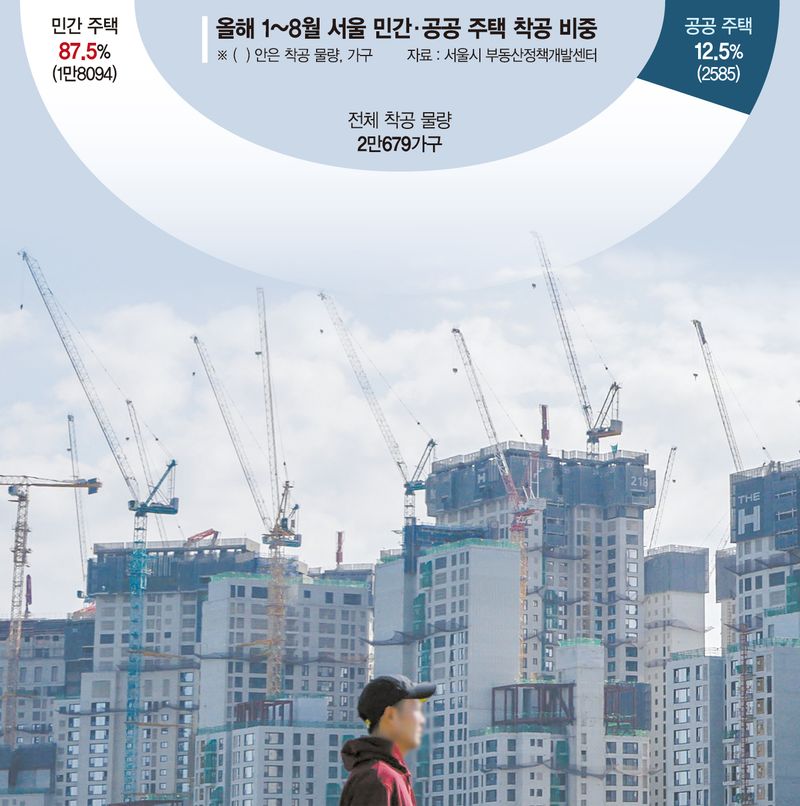
■ Private sector accounts for 88% of construction starts; limits of public-led supply
According to the Seoul Metropolitan Government’s Real Estate Policy Center on the 20th, of the 20,679 homes that began construction in Seoul from January through August this year, 18,094 were private-sector homes, accounting for 87.5% of the total. Just 2,585 public homes (12.5%) began construction. Although the government has emphasized public-led housing supply since the start of its term, the limits of a public-centered approach have become clear in Seoul, where private-sector redevelopment and reconstruction projects are driving supply.
The government’s Jan. 29 Urban Housing Supply Expansion and Acceleration Plan included the Yongsan International Business District in Yongsan-gu (10,000 homes), Camp Kim, a former U.S. military base (2,500 homes), and Taereung CC in Nowon-gu (6,800 homes), among other sites. But the projects have made virtually no progress, as the special-act amendment that would provide their legal basis remains pending, or residents strongly oppose the projects.
“It’s true that expectations have fallen considerably because public-led supply is going nowhere,” one expert said. “Meanwhile, the private sector appears to be driving close to 90% of housing supply in Seoul.” The expert added, “Ultimately, obstacles to all supply projects, whether public or private, need to be decisively removed.”
Professor Kim Jun-hyeong of Myongji University also stressed, “Revitalizing private-sector redevelopment projects is inevitably the primary means of addressing Seoul’s housing problem. Public-led supply, whether through public redevelopment projects or new-town development, should serve as a supporting measure.”
■ Transfer restrictions block construction starts
At a Cabinet meeting he chaired at the Blue House that day, President Lee Jae-myung said, “I hope you will wage a housing-supply blitz by dramatically shortening, as much as possible, the time required for everything from preparing housing sites to obtaining the various permits and approvals and beginning construction, without being bound by existing practices and procedures.” The government is also working to ease some restrictions on private-sector projects. Under the Aug. 13 measures, it changed the basis for calculating the loan-to-value (LTV) ratio for relocation loans from the appraised value of assets before redevelopment to their appraised value afterward, and lowered the consent threshold for establishing a redevelopment association from 75% to 70%.
However, the government remains lukewarm about easing the “restriction on transferring association-member status,” still regarded as a major obstacle. Under the current system, in areas designated as overheated speculative zones, association-member status cannot be transferred after approval to establish an association for reconstruction projects, or after approval of a management and disposal plan for redevelopment projects. In effect, properties become impossible to sell once a project gets underway.
Association members who cannot afford their contributions or oppose a project have no way to sell their homes and leave. This is likely to cause internal conflicts and delay projects.
Professor Kim criticized the government, saying, “The problem is that it views association members as ‘speculators.’ It makes no sense to talk about revitalizing redevelopment projects or supplying housing while blocking the exit.” Seoul Mayor Oh Se-hoon also called on the government to ease the regulations at a recent parliamentary audit, saying, “If the restriction on transferring association-member status were lifted temporarily for just three years, sources of conflict within associations would be significantly reduced.”
The government is considering allowing the floor-area ratio for private developments to reach up to 1.2 times the legal limit (120%), but is expected to exclude the three Gangnam districts and Yongsan-gu. Professor Kim said, “If conditions are attached to the easing measures, such as excluding certain areas, this could become ‘limited supply at all costs.’ A bold decision is needed to lift regulations without conditions and address any problems afterward.”
[email protected] Jeon Min-gyeong, Lee Jong-bae Reporter