Ruling party fails to decide on '52-hour workweek exemption'... 'Deliberations without pinning down the timing'
- Input
- 2026-10-20 18:24:23
- Updated
- 2026-10-20 18:24:23
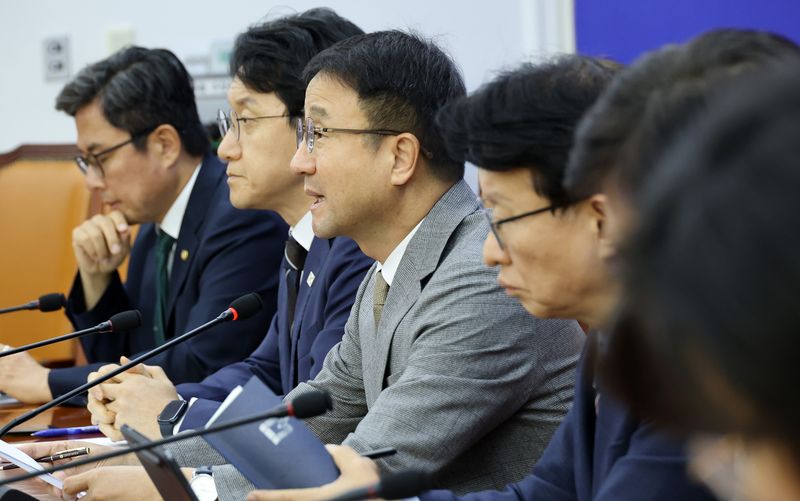
The DPK had initially considered naming the bill the “Special Act on Mega Special Zones” but decided to change it to the “Special Act on Ultra-Regional Special Zones.” The move appears to reflect concerns raised by some that limiting the bill to supporting mega-projects, including the southwestern region’s semiconductor cluster, could prompt accusations of “preferential treatment for Honam.” The People Power Party (PPP) called for the 52-hour workweek exemption to be pushed through this time.
■ Around 320 regulatory exemptions for companies and others to choose from
Han Byung-do, the DPK floor leader, said at the National Assembly of the Republic of Korea that day, announcing the introduction of the Special Act on Ultra-Regional Special Zones: “This law will expand opportunities for growth, now concentrated in the Seoul metropolitan area, across the country and support each region in leading Korea’s future through its strategic industries.”
The bill includes around 320 “menu-style” regulatory exemptions and around 40 policy-support packages, allowing companies and local governments to choose the exemptions they need. It covers everything from infrastructure development and facility construction to improving conditions for people to settle in an area, making use of talent, research and development (R&D), working hours, and exemptions tailored to strategic industries.
The bill also provides support for regulatory exemptions not specified in law but needed by companies, through expedited confirmation, regulatory sandboxes, temporary permits, and demand-responsive regulatory waivers. It also establishes special renewable-energy pilot zones and a supply system based on “local production and local consumption,” producing and consuming locally the clean energy companies require.
The bill also includes fiscal, tax, and financial support, such as the creation of special grants; fiscal assistance using the National Growth Fund; preferential policy financing and credit guarantees; support for startups and venture companies; and tax and levy reductions. It also requires companies to take out liability insurance for damages and includes provisions to prevent real estate speculation. These post-implementation safeguards are intended to ensure that the bill’s purpose of balanced regional growth is not undermined.
■ Labor exemptions to be deliberated separately
The key point of contention is labor exemptions, including an exemption from the 52-hour workweek for high-income earners and R&D workers. Whether the provision makes it into the final version is expected to be crucial to the bill’s passage. The business community says labor regulations need to be eased to keep pace with rapidly changing industrial conditions and competition in R&D. It argues that labor regulations are hindering efforts to remain competitive, particularly amid a surge in semiconductor demand as artificial intelligence (AI) spreads.
Labor groups, by contrast, are objecting, saying that exemptions within the special zones could lead to a broader easing of labor regulations. Taking into account the demands of both industry and labor, the DPK introduced two bills: one with labor exemptions and one without. It plans to review both together and draw up a final version.
Han said, “We are well aware that there are diverse views across all sectors on labor-hour exemptions and other key issues in the bill,” adding, “We will not pin down the timing of its passage and will allow ample time for deliberation and discussion.” He added, “We will listen broadly to voices from all quarters and draw up a final version through a subsequent joint review.”
■ Plans to expand PPAs and cut electricity bills
A separate bill from the National Assembly’s Trade, Industry, Energy, SMEs and Startups Committee is also expected to be introduced as early as next week. The Special Act on Ultra-Regional Special Zones, initially assigned to that committee, was transferred to the National Policy Committee on the grounds that deregulation was its central focus. A committee official said that some demands from industry were left out in the process.
DPK lawmaker Jeong Jin-wook, a member of the Trade, Industry, Energy, SMEs and Startups Committee, plans to introduce a bill adding provisions to expand Power Purchase Agreements (PPAs) and other measures to the version unveiled that day. The proposal would extend PPAs, currently permitted only for renewable-energy power generators, to sources such as liquefied natural gas (LNG) combined heat and power generation.
The aim is to compensate for the weather-dependent intermittency of renewable energy and broaden companies’ options to include non-renewable sources capable of providing a stable power supply. The proposal is also understood to take into account that directly supplying electricity and heat produced by combined heat and power generation could improve efficiency in semiconductor processes, which require both enormous amounts of electricity and high-temperature heat (steam).
Jeong’s proposal also includes an exemption allowing companies in the special zones to receive discounts of up to 50% on their electricity bills. It also includes preferential military-service provisions for companies in the zones designated as eligible for military-service placements when they enroll employees as industrial technical personnel, with the aim of encouraging investment.
■ PPP calls for exemption from 52-hour workweek
The PPP called on the DPK to take a more forward-looking position on labor exemptions. During the earlier passage of the Special Act on Semiconductors, the DPK also faced opposition from labor groups and passed the bill only after removing the provision allowing an exemption from the 52-hour workweek.
Choi Su-jin, the PPP’s senior deputy floor spokesperson, told reporters after a meeting on responses to the parliamentary audit that day, “The 52-hour workweek is meaningless for jobs involving research into cutting-edge technologies,” and continued, “The DPK is only now catching up, but I hope the 52-hour workweek will be eased this time.”
[email protected] Kim Hyeong-gu Reporter