[Editorial] Restoring confidence, not stimulus, is the way to revive a flagging stock market
- Input
- 2026-10-20 18:20:26
- Updated
- 2026-10-20 18:20:26
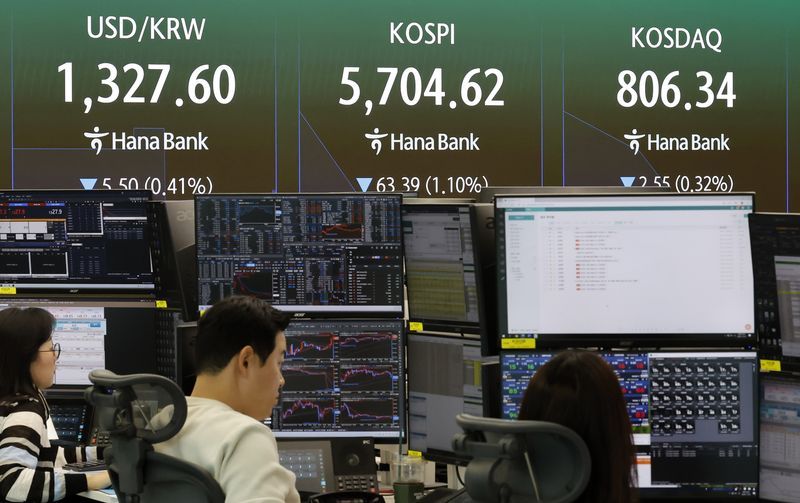
The performance of our stock market, which had been doing well, over the past few months has been dismal. The KOSPI has fallen 17.11% so far this month, the worst performance among the world’s major stock markets. Indices have also fallen in Indonesia (14.59%), China (7.4%), Japan (2.14%) and Taiwan (1.73%), but their declines have been smaller than ours.
As President Lee said, the “Korea discount”—the fact that domestic companies are valued less highly than their overseas competitors—is a longstanding challenge. The KOSPI’s price-to-book ratio (PBR) is indeed far below those of the United States, Taiwan and India. The KOSPI’s PBR is estimated at around 1.9 times this year, compared with 4.9 times in the United States, 4 times in Taiwan and 2.8 times in India—a wide gap. A lower PBR means a company is undervalued. At the root of the problem are opaque corporate governance, meager shareholder returns, and conflicts of interest between controlling shareholders and minority shareholders.
What must be guarded against is the government stepping in to prop up the index. Last May, the National Pension Service raised its target allocation to domestic stocks to 20.8%, but the value of domestic listed stocks fell by about 182 trillion won in just over three months. Critics also say that a single-stock leveraged exchange-traded fund (ETF), rushed through without due care, has sharply increased market volatility and caused investment losses of at least 2 trillion won. Lee Chan-jin, Governor of the Financial Supervisory Service, admitted, “There were parts of the review that we expedited to meet the schedule,” but the government bears considerable responsibility.
Of course, problems that have persisted for decades are not easy to solve through market forces alone. The government also has a role to play, including setting a course for normalizing the stock market. But if politicians set specific index targets, mobilize pension funds or force companies to increase shareholder returns, foreign investors will see this as a danger signal. The recent wave of selling by foreign investors is likely not unrelated to this.
Trust is not easy to earn with a single remark. The right approach is to improve corporate fundamentals. We must create a system in which companies that make their governance more transparent and increase dividends and cancellations of treasury shares are valued fairly. Companies that increase shareholder returns should be offered the “carrot” of tax benefits, while the “stick” should be used to quickly drive failing companies out of the market.
The government and financial authorities should include a timetable for improving corporate governance and expanding shareholder returns in their normalization measures, instead of setting index targets. They should codify the principle that pension funds will not be used to prop up the index, and review listing assessments for leveraged ETF products and investor protection measures. The National Assembly, too, should refrain from excessive legislation that increases the burden of litigation without providing means to defend management control. A passage in The Analects of Confucius says, “Without trust, one cannot stand.” What the stock market needs now is not intervention but trust.