Nvidia Gains, but Investors Lose in Won Terms as Exchange Rate Hurts Korean Retail Investors in U.S. Stocks
- Input
- 2026-10-20 18:20:05
- Updated
- 2026-10-20 18:20:05
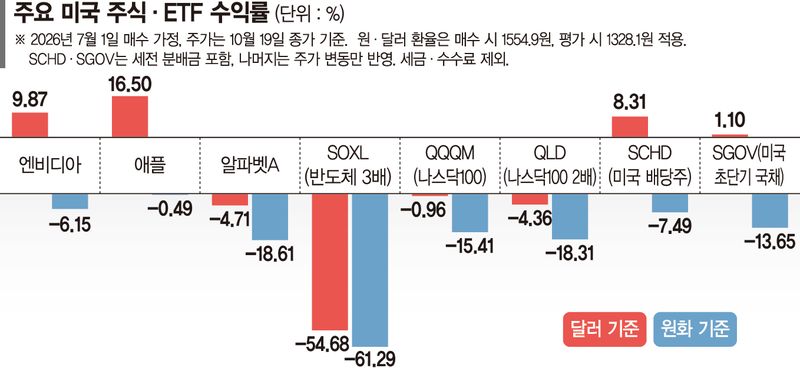
■Retail investors who bought 10 trillion won worth of stocks in Q3 cry out
The won-dollar exchange rate closed at 1,328.1 won in Seoul’s foreign-exchange market on the 20th, down 2.2 won from the previous day. It fell to its lowest level in about two years for a second consecutive day. Compared with 1,554.9 won on July 1, the start of the third quarter this year, it was 226.8 won (14.59%) lower—meaning exchange-rate fluctuations alone had reduced its value by about 15% in just over three months.
Domestic investors continued buying U.S. stocks during this period. According to figures compiled by SEIBro, run by the Korea Securities Depository, domestic investors’ net purchases of U.S. stocks from July to September totaled $7.60603 billion (about 10.1016 trillion won). They also made an additional $4.21738 billion in net purchases this month through the previous day.
Assuming investors exchanged won for dollars and bought U.S. stocks on July 1, share prices would have to rise 17.08% to bring them back to their initial investment, based on the exchange rate that day. If stock prices remained unchanged, exchange-rate movements alone would reduce the value of their holdings in won by 14.59%. In fact, domestic investors’ holdings of U.S. stocks fell 5.89%, from $194.29064 billion at the end of September to $182.84726 billion on the 16th of this month.
For investments made after currency exchange in the first half of this year, applying the average exchange rate of 1,484.6 won means that even a 10% rise in share prices would still leave investors with a 1.60% loss in won terms. Share prices would have to rise 11.78% to offset the decline in the exchange rate.
■Nvidia Gains, but Investors Still Lose in Won Terms
Even leading U.S. stocks whose share prices rose produced losses in won terms. From July 1 through the previous day, Nvidia’s share price climbed 9.87%, from $197.58 to $217.09, but its return in won terms was -6.15%. An investment of 10 million won would be worth only about 9.38 million won. Apple’s share price also rose 16.50%, from $294.38 to $342.96, but its return in won terms was -0.49%.
Alphabet A, Google’s parent company and the top net-purchased individual stock in the third quarter, faced an even greater burden from the exchange rate. Its share price fell 4.71%, from $361.21 to $344.18, but its loss in won terms was 18.61%.
Losses were even steeper for Direxion Daily Semiconductor Bull 3X Shares (SOXL), an exchange-traded fund (ETF) that tracks three times the daily return of a semiconductor index and was the most heavily net-purchased U.S. stock in the third quarter. Its price plunged 54.68%, from $217.55 to $98.60. Including the exchange rate, its return in won terms was -61.29%.
ETFs that invest in indexes also failed to avoid foreign-exchange losses. QQQM’s price fell just 0.96% in dollar terms, but its loss in won terms reached 15.41%. QLD, which tracks twice the daily return of the Nasdaq-100 Index, also saw its price decline 4.36%; factoring in the exchange rate, its loss widened to 18.31%.
Dividend stocks and Treasury ETFs, considered stable investments, also resulted in losses when converted into won. SCHD, a U.S. dividend-stock ETF, returned 8.31% in dollars when price gains and distributions were combined, but posted a 7.49% loss in won terms. SGOV, a U.S. ultra-short-term Treasury ETF, likewise returned 1.10% in dollars including distributions, but recorded a 13.65% loss in won terms.
[email protected] Joo Won-gyu Reporter