Brokerage stocks struggle... Can year-end dividends provide a cushion?
- Input
- 2026-10-20 18:20:03
- Updated
- 2026-10-20 18:20:03
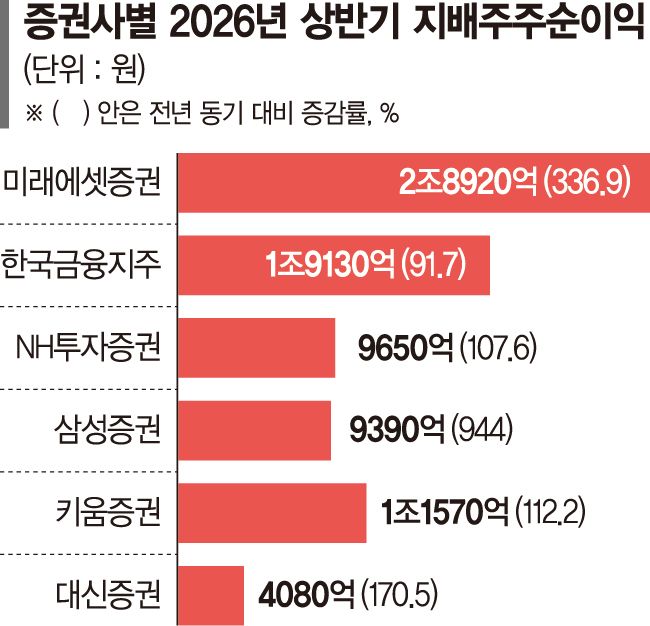
According to the financial investment industry on the 20th, the six firms—Mirae Asset Securities, Korea Investment Holdings, NH Investment & Securities, Samsung Securities Co., Ltd., Kiwoom Securities and Daishin Securities—are expected to post combined net income attributable to controlling shareholders of 10.4 trillion won this year. That would be a record, up 48.9% from last year. Next year’s net income, by contrast, is expected to fall 27.6% from this year to 7.5 trillion won.
The effects of the stock market correction are already expected to be reflected in second-half results. The six firms’ combined net income attributable to controlling shareholders for the third quarter is forecast at 812.4 billion won, down 58.8% from the same period last year. Despite an increase in fee income, declines in the stock market and worsening valuation gains and losses on securities as market interest rates rise are expected to weigh on results.
Share prices have fallen amid concerns about slowing earnings, but expectations remain that, for the full year, strong first-half results will expand the funds available for dividends. Samsung Securities Co., Ltd.’s projected dividend per share this year is 6,500 won, with a dividend yield of 8.2%. Kiwoom Securities is forecast to pay 18,000 won per share, for a dividend yield of 8.1%.
The key question is whether dividends will remain attractive next year. If earnings decline, dividends per share could fall even if the payout ratio rises. Samsung Securities Co., Ltd.’s dividend per share next year is estimated at 5,200 won, 20% below this year’s projection. Kiwoom Securities is also forecast to see a 16.7% decline from this year, to 15,000 won.
Accordingly, next year’s projected dividend yields, based on the same share prices, fall to 6.6% for Samsung Securities Co., Ltd. and 6.7% for Kiwoom Securities. These figures are below this year’s projected yields in the 8% range, but the calculation suggests the firms could maintain yields in the 6% range even after accounting for lower earnings.
Researcher Kim said, “Applying an average return on equity (ROE) of 11% that reflects the decline in earnings in 2027, a price-to-book ratio (PBR) of 1.1 times is possible.” Kim added, “Even if the stocks are valued based on next year’s profitability rather than this year’s record earnings, there is room for their current share prices to be re-rated.”
[email protected] Choi Du-seon Reporter