“I thought it was a boil on the skin” ... The horrifying discovery inside a young child
- Input
- 2026-10-20 19:00:00
- Updated
- 2026-10-20 19:00:00
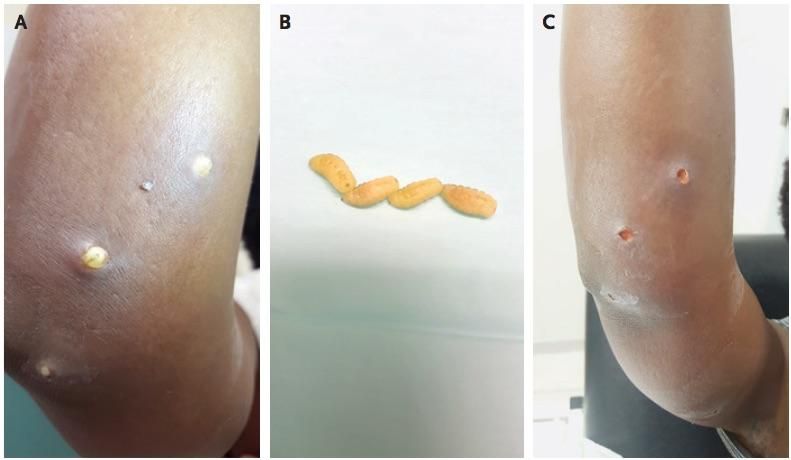
[Financial News] A red lump bulged from the smooth skin of a young child. At first glance, it looked like nothing more than a badly infected boil or ordinary dermatitis. But a closer examination revealed the horrifying truth: a live fly larva was growing inside.
On the 5th (local time), the British medical journal BMJ Case Reports published a rare case from the pediatric emergency department at St Mary's Hospital in London, UK, where doctors removed a fly larva from the skin of a young girl who had returned from a trip to Gambia, Africa.
The precise diagnosis made by the medical team was “furuncular myiasis.” The culprit burrowing into the child's skin was a Tumbu fly larva. Tumbu flies are found mainly in sub-Saharan Africa.
Tumbu flies do not infect people by biting them directly, as mosquitoes do. Instead, female flies lay eggs in sand or on laundry that has not fully dried. When the larvae hatch and come into contact with human skin, they penetrate the tissue in a stealthy way. Once settled beneath the skin, a larva makes a small opening at the surface and breathes through it as it gradually grows. Initially, it can look like a mosquito bite, but it gradually swells and is characteristically accompanied by pain and bacterial infection (cellulitis).
The challenge is how to remove the larva. Because it is embedded deep beneath the skin, surgical treatment (an incision) may be necessary. For a young child in particular, the pain and fear involved in surgery made this a difficult situation in which even general anesthesia had to be considered.
Instead of reaching for a scalpel, however, the British medical team ingeniously used a nonsurgical approach with “topical anesthetic cream.” They applied an ointment containing an anesthetic around the lesion, encouraging the larva to emerge on its own or making it easier to remove. The result was a complete success, and the child was able to have the larva safely removed without the pain of surgery.
The medical team warns that anyone who develops a persistent boil-like skin lesion after traveling to a tropical region such as Africa should be sure to disclose their travel history and get checked for infection. In areas where the infection is present, an essential preventive measure is to hang wet clothes out to dry and then iron them with a hot iron to kill the larvae.
It is especially important never to try to squeeze out a suspected insect beneath the skin with your fingers or a sharp tool. If the larva bursts inside or is only partially removed, it can lead to severe inflammation and secondary tissue damage. The red lump that seemed like a simple boil—and the parasite quietly breathing inside it—clearly shows just how important rigorous hygiene is when traveling abroad.
[email protected] Jeon Sang-il Reporter