"AI: A Tool for Expanding Work, Not a Threat Requiring a Change of Major"
- Input
- 2026-10-20 17:57:14
- Updated
- 2026-10-20 17:57:14
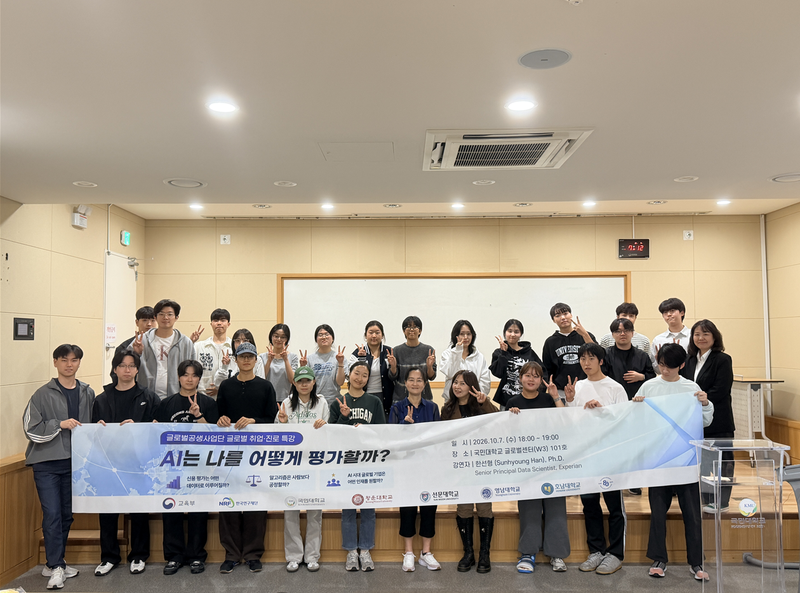
[Financial News] Amid rapid advances in artificial intelligence (AI), an assessment has emerged that the core competency required of future talent is not changing majors, but using AI to expand existing expertise—a form of "work leverage."
Kookmin University's Global Coexistence Project Group released details on the 20th of a global careers and career paths special lecture held on the 7th at the university's Global Center in Seongbuk-gu, Seoul. The lecture was organized as part of the Humanities and Social Sciences Convergence Talent Development Program (HUSS), supported by the Ministry of Education and the National Research Foundation of Korea.
Han Seon-hyeong, a senior data scientist at Experian, one of the three major U.S. credit reporting companies, spoke at the event and outlined the core competencies future talent will need, drawing on examples of AI use in the global financial industry.
Addressing students in the humanities and social sciences, Dr. Han emphasized, "AI is not a threat that requires you to change your major; it can be 'work leverage' for expanding your existing expertise. By adding data and AI skills and business judgment to the ability to define problems, you can build new competitive strengths beyond the boundaries of your major." Dr. Han continued, "In the AI era, what matters is not so much learning the technology itself as being able to define problems, critically verify AI-generated results, and connect them to real-world decision-making." Dr. Han explained, "The core competitiveness global companies seek also lies in the ability to solve problems amid uncertainty and collaborate with experts from diverse fields."
The lecture also touched on the use of AI in finance and related ethical issues. Dr. Han noted, "AI algorithms may be able to reduce human bias, but they also have the limitation of reproducing biases embedded in training data." Dr. Han added, "Alongside technical accuracy, fairness, explainability, and ethical judgment must also be taken into account."
Ko Hye-seon, a research professor with Kookmin University's Global Coexistence Project Group who organized the special lecture, said, "I hope students will, rather than fear the development of AI, draw on their grounding in the humanities and social sciences to combine AI with their own expertise and define and solve problems independently."
Meanwhile, Kookmin University's Global Coexistence Project Group has formed the "HUSS Global Coexistence Consortium" with Kwangwoon University, Sun Moon University, Yeungnam University, and Honam University, and runs a program to develop convergence talent who will lead a sustainable society.
[email protected] Kim Man-gi Reporter