Korea Eximbank and KAI chiefs draw a line on sale rumors: “No current plans”
- Input
- 2026-10-20 17:20:21
- Updated
- 2026-10-20 17:20:21
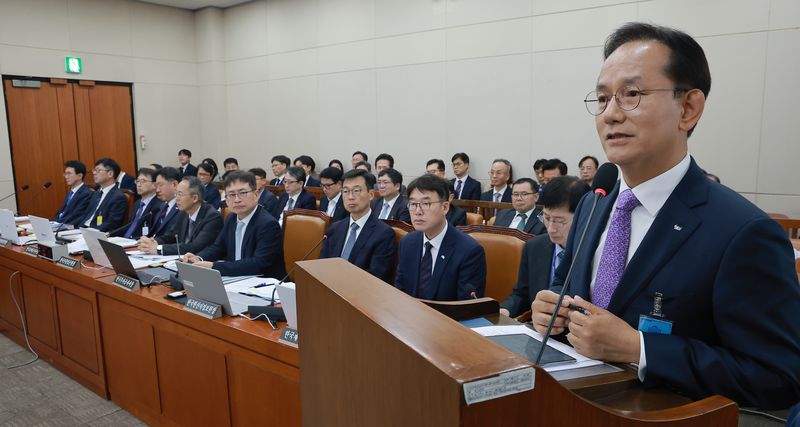
[Financial News] The heads of the Export-Import Bank of Korea and KAI both drew a line on controversy surrounding the possible privatization of Korea Aerospace Industries (KAI) and its potential acquisition by Hanwha Group.
Hwang Gi-yeon, president of the Export-Import Bank of Korea, said there are currently no plans to sell its stake in KAI, while KAI President Kim Jong-chul voiced concern that the aerospace industry’s competitive structure could be undermined if Hanwha secured management control. However, as the bank did not rule out the possibility of a sale in the future, controversy over restructuring KAI’s governance is expected to continue.
At a parliamentary audit by the National Assembly’s Finance and Economy Planning Committee on the 20th, Hwang said, “There are currently no plans to sell KAI,” adding, “The consulting project was not undertaken on the premise of privatization or a sale.” Earlier, last August, the Export-Import Bank of Korea commissioned a consulting project worth 1.8 billion won on “Strengthening the Competitiveness of the Space and Aerospace Industries.” The project included measures to foster global anchor companies in space and aerospace, prompting suspicions that it was intended to pave the way for KAI’s privatization or a restructuring of its governance. The controversy intensified when Hanwha Group increased its stake in KAI to 15.89% that same month. The Export-Import Bank of Korea is currently KAI’s largest shareholder, with a 26.41% stake, while Hanwha is its second-largest shareholder.
Hwang explained that the consulting project was initiated after “we received a proposal following the public briefing on the vision for developing advanced industries in the Yeongnam region last July, after consulting with the Ministry of Economy and Finance,” adding, “We wanted to hear a range of opinions on what role policy financial institutions should play in the space and aerospace sector.” In response to comments that Hanwha’s stake increase coincided with the commissioning of the project, he said, “I didn’t know Hanwha was buying KAI shares on the open market,” and explained, “The sale of KAI shares was not included in the scope of the project.” He also said he had received no contact about a KAI sale from the presidential office or political circles.
However, Hwang left the door open to a possible sale of the stake in the future, saying, “It is difficult to speak definitively about plans for the future.”
Kim Jong-chul, the KAI president who appeared as a witness that day, also stated his position on restructuring the company’s governance.
Kim said, “Everyone wants to own KAI, but not just anyone can,” adding, “I don’t think KAI’s governance will change without the consent of its members.” He voiced concern, saying, “Because it would create a monopoly issue, I think the competitive structure would be significantly undermined,” and, “There is a possibility that the aerospace industry ecosystem could shrink.”
He also agreed on the need for KAI to be independently managed. Kim said he had never received instructions from the presidential office or ruling-party figures with a KAI sale in mind, and explained, “Since it is a defense contractor, I believe there would be some level of government approval or oversight.”
He went on to stress, “Employees and the local community are very concerned, but we will firmly safeguard what we need to protect,” adding, “Whatever changes occur in the governance structure, I hope they will proceed in a way that advances the aerospace industry and strengthens the competitiveness of K-defense.”
[email protected] Jeong Won-il Reporter