Kakao draws a line on block deals and capital increases; ₩300 billion in shareholder returns after spin-off
- Input
- 2026-10-20 17:03:24
- Updated
- 2026-10-20 17:03:24
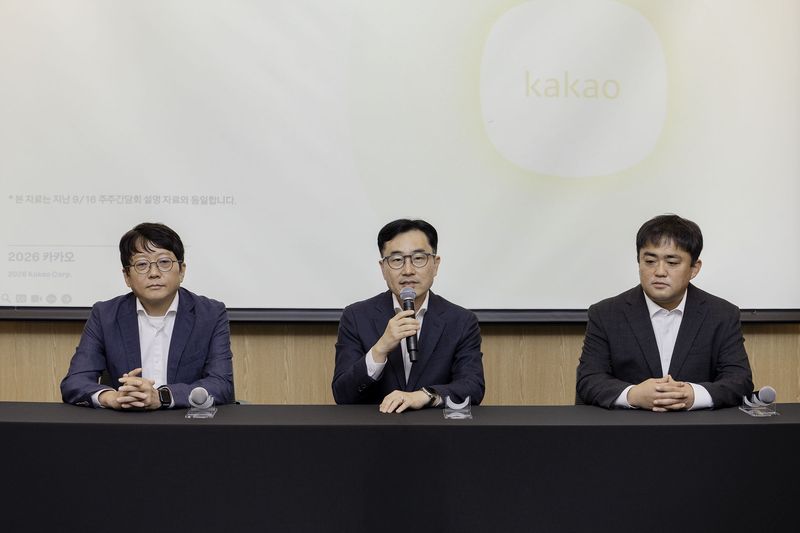
Kakao said on the 20th that it had held its “Second Retail Shareholder Meeting” at the FKI Tower Conference Center in Yeouido, Seoul.
The meeting, held both online and in person for about an hour and a half, was attended by senior executives, including Kim Do-young, CEO-designate of Kakao. They actively engaged with retail shareholders on the rationale for the spin-off, post-spin-off growth strategies, and ways to enhance corporate and shareholder value.
Discussions at the meeting focused on growth strategies after the spin-off and ways to enhance shareholder value.
Retail shareholders raised a barrage of questions, including concerns about shareholder losses amid the falling share price, the possibility of a block deal involving a stake in connection with founder Kim Beom-su’s legal risks, and rumors of a planned third-party allotment paid-in capital increase.
Shin Jong-hwan, Kakao’s chief financial officer (CFO), replied, “The block deal is completely unfounded and could never happen,” adding, “All of management feels a heavy sense of responsibility over the continuing weakness in the share price.”
Addressing concerns about a third-party allotment paid-in capital increase by the newly established Kakao AI, he stressed, “We have never discussed or considered it,” and said, “Kakao AI can cover the infrastructure and computing (chip) investments it will need in the future with its own cash-generating capacity alone.”
In response to a question about whether Kakao could be undervalued by the market because of its subsidiary-centered business structure, Kakao said it would disclose detailed performance and growth strategies for each major business, including tech finance, content and mobility, after the spin-off so that the value of each business is fully reflected in market valuations. It also said it would narrow the gap between net asset value and market valuation.
Kakao said the need for the spin-off arose because it had faced limits in focusing on AI, KakaoTalk, advertising and commerce while also pursuing the growth and investment of key affiliates within a single decision-making structure. It stressed that structural change was needed to keep pace with rapid changes in the AI industry, and that the spin-off would strengthen expertise in each business and speed up decision-making, thereby enhancing corporate and shareholder value.
Kakao said that after the spin-off, Kakao would use 30% of its subsidiaries’ dividends and 30% of investment gains, respectively, to fund shareholder returns, and would pursue treasury-share buybacks and cancellations totaling 300 billion won. It also reaffirmed Kakao AI’s plan to use 20–35% of its adjusted standalone shareholder free cash flow (FCF) for shareholder returns, and to raise the return ratio to as much as 40% if FCF increases by 50% or more from the previous year.
Kim, the CEO-designate, said, “The main goal of this restructuring is to increase corporate and shareholder value through the spin-off,” adding, “As we execute our growth strategy swiftly, we will do our utmost to build trust by fully explaining the rationale for the spin-off and our future growth strategy to shareholders and listening to their views.”
Kakao plans to hold a briefing for major overseas investors next month and begin the process of seeking a special resolution at the general meeting of shareholders.
[email protected] Jang Min-gwon Reporter