“To Stop Large-Scale Drug Smuggling”: Korea Customs Service Activates Three-Tier Enforcement Network for Maritime Cargo
- Input
- 2026-10-20 16:26:59
- Updated
- 2026-10-20 16:26:59
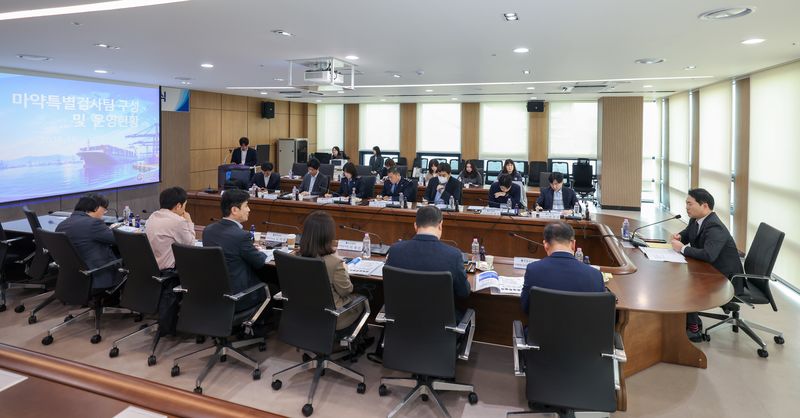
The Korea Customs Service said Deputy Commissioner Park Heon visited Incheon Customs, a key hub for maritime cargo clearance, on the 20th and chaired a “Progress Review Meeting on Special Drug Inspections.” The meeting was held to review the field operations and enforcement system of the Special Drug Inspection Team, the dedicated unit for intercepting drugs in general import cargo. The team completed staffing on the 14th of last month and officially launched operations. It is currently operating with 36 members across five teams at four major customs offices nationwide, including Incheon International Airport, Incheon, Busan (North Port and New Port), and Pyeongtaek.
The Korea Customs Service said the pattern of drug inflows into the country had reached a major turning point, following the detection of large-scale drug smuggling by sea for three consecutive years. In the past, smuggling mainly involved small, dispersed quantities (phases 1 and 2), concealed on overseas travelers or sent through express cargo and international mail. But as methods have evolved toward large-scale smuggling (phase 3) using port containers and ships, the country has now fully entered an era of “large-scale drug-smuggling threats,” the agency said.
The scale of smuggling surged after cocaine was found in ships and refrigerated containers at Ulsan’s Onsan Port (28.4 kg) and Busan New Port (33.2 kg) in 2024. Last year, the Korea Customs Service and the Coast Guard jointly seized 1.7 tonnes of cocaine at Okgye Port in Gangneung, while 600 kg and 333 kg of cocaine were also intercepted at Busan Port. Large-scale smuggling has continued this year, with 637 kg of cannabis intended for smuggling through Incheon Port detected.
At the meeting, the Korea Customs Service focused on reviewing detailed implementation plans for three key tasks to counter the threat of large-scale drug smuggling. It has established a “multi-stage, three-tier monitoring and enforcement network” for general import cargo: first, immediate inspection by opening the cargo; second, inspection by the Special Drug Inspection Team; and third, general import inspection. The inspection process has been extended to cover stages after cargo enters bonded areas, making the enforcement network more comprehensive.
The agency also plans to refine its information analysis model, drawing on about 200 seizure cases collected from overseas agencies such as the World Customs Organization (WCO) and U.S. Customs and Border Protection (CBP), to improve the accuracy of identifying high-risk cargo. It has also standardized on-site inspection procedures, deploying advanced screening equipment—including container scanners, Raman spectrometers, ion scanners, endoscopic cameras and mobile X-ray units—as well as drug-detection dogs, while increasing the use of destructive inspections and the deployment of specialist X-ray image interpreters.
Deputy Commissioner Park said, “To respond to the threat of large-scale drug smuggling, we must change every method we have used up to now.” He called on customs offices to “feel a sense of responsibility as the first line of defense protecting the border and focus all their capabilities on ensuring that not even the slightest gap is left.”
Meanwhile, the expansion and growing organization of drug smuggling by sea is attributed to major drug-producing countries such as those in South America and Southeast Asia, as well as the expanding distribution networks of international drug cartels operating through global hub ports. Unlike express shipments or mail, container cargo can conceal and transport huge quantities of drugs in a single shipment, and smugglers are believed to exploit the difficulty of conducting thorough inspections of commercial cargo. Accordingly, customs authorities plan to step up international joint investigations, moving beyond surveillance by customs authorities alone and working more closely with domestic agencies such as the police, Coast Guard and prosecutors, as well as customs authorities in Southeast Asia and the Americas.
[email protected] Kim Won-jun Reporter