Research on the Jeju uprising and Yeosu-Suncheon 10·19 expands... Six institutions in Honam and Jeju hold joint discussions
- Input
- 2026-10-20 16:06:00
- Updated
- 2026-10-20 16:06:00
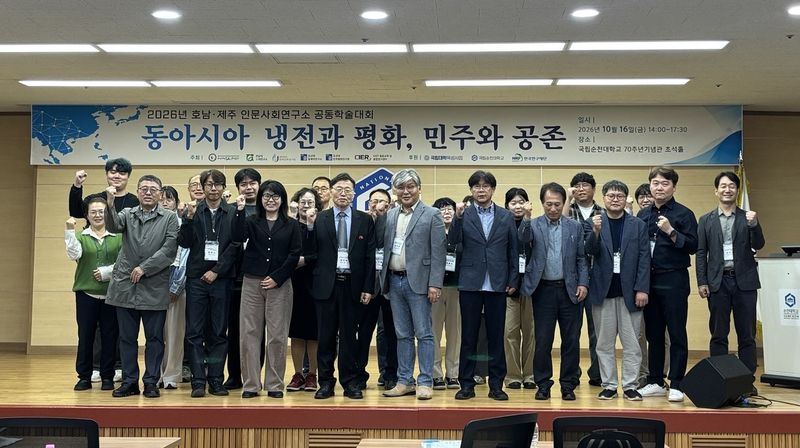
【Financial News, Jeju = Reporter Jeong Yong-bok】 Six research institutions in Jeju and Honam discussed ways to connect the history of state violence during the Cold War, including the Jeju uprising and the Yeosu-Suncheon 10·19 Incident, with changes in local communities and education on democracy and peace.
According to Jeju National University’s Tamna Culture Research Institute on the 20th, the 2026 Fall Joint Academic Conference of Honam and Jeju Institutes for Humanities and Social Sciences was held on the 16th at Choseok Hall in the 70th Anniversary Memorial Hall of National Suncheon University, under the theme “The Cold War and Peace in East Asia, Democracy and Coexistence.”
Six institutions jointly took part in the conference, including Jeju National University’s Tamna Culture Research Institute, the Institute of Humanities at National Suncheon University, the May 18 Institute at Chonnam National University, Chosun University’s Northeast Asian Research Institute and Institute for Democracy and Peace, and the Center for Convergence Education and Convergence Research at Gwangju Institute of Science and Technology (GIST).
The conference featured two sessions, “The Cold War and Peace” and “Democracy and Coexistence,” followed by a general discussion. Key topics included the impact of the Cold War in East Asia on local communities, the preservation of historical records, and research directions for restoring democracy and communities.
In the first session, Kang Seong-ho, head of the Institute of Humanities at National Suncheon University, presented on the Cold War in East Asia and changes in local communities. Kim Dong-hyeok, head of GIST’s Center for Convergence Education and Convergence Research, introduced research analyzing the long-term Cold War structure with a focus on knowledge, emotion and life. Chosun University’s Northeast Asian Research Institute presented its work to collect, describe and translate materials on modern and contemporary Korean history held by a Russian archival institute, and to build a database.
The second session continued with research on democracy and coexistence. Ji Byeong-geun, head of Chosun University’s Institute for Democracy and Peace, presented a model of democratic civic education in which citizens resolve community issues through discussion and deliberation. Im Myeong-gyu, a research fellow at the May 18 Institute at Chonnam National University, presented research on multi-layered democracy for an inclusive society.

Kim Chi-wan, head of Jeju National University’s Tamna Culture Research Institute, presented under the title “Qumda Humanities in an Age of Global Anomie: Toward Life in Archipelagos and Hybrid Ways of Knowing.” The presentation explored, from a humanities perspective, life in island regions and the relationships between different cultures and forms of knowledge in an era when social norms and order are in flux.
Since 2018, Jeju National University’s Tamna Culture Research Institute and the Institute of Humanities at National Suncheon University have conducted joint research on the historical links between the Jeju uprising and the Yeosu-Suncheon 10·19 Incident. The two events are historically connected through the refusal by some soldiers of the Republic of Korea Army’s 14th Regiment, stationed in Yeosu, to obey an order to deploy to suppress the Jeju uprising in 1948.
In 2024, the two institutions published two volumes in a joint research series, including “Solidarity for the Memory of the Jeju uprising and Yeosu-Suncheon 10·19” and “Solidarity for Accountability for the Jeju uprising and Yeosu-Suncheon 10·19.” In April this year, they also held a joint academic conference comparing Taiwan’s 2·28 Incident with Jeju 4·3 and Yeosu-Suncheon 10·19.
The conference was significant in that it connected this research foundation with institutions in the Honam region that focus on research into democracy and peace. At the general discussion, researchers from four institutions, including Jeong Seong-yun, a research fellow at the May 18 Institute at Chonnam National University, took part to interpret the historical experience of the Cold War from a contemporary perspective and discuss directions for future academic collaboration.
“Looking back at the history of the Cold War means examining how the wounds of the past continue to affect our lives and relationships today, and seeking together a path toward peace, democracy and coexistence,” said Kim Chi-wan, head of the institute. “I hope the research underway at each institute will deepen one another’s questions and lead to new opportunities for joint research.”
[email protected] Jeong Yong-bok Reporter