KOSDAQ (Korea Securities Dealers Automated Quotations) tiered system expected to stem blue-chip departures and attract capital ... sidelining of small- and mid-cap stocks remains a challenge
- Input
- 2026-10-22 15:42:53
- Updated
- 2026-10-22 15:42:53
[Financial News] A ‘tiered system’ that divides the KOSDAQ market according to company size and performance, among other factors, is drawing attention as an alternative to preventing blue-chip companies from leaving. The idea is to reduce demand for transfers to KOSPI by enabling strong companies to receive fair valuations and attract institutional and foreign investment while remaining on KOSDAQ. However, the risk that funds will concentrate in the top tier, potentially deepening the marginalization of small- and mid-cap stocks and early-stage growth companies, remains a challenge.
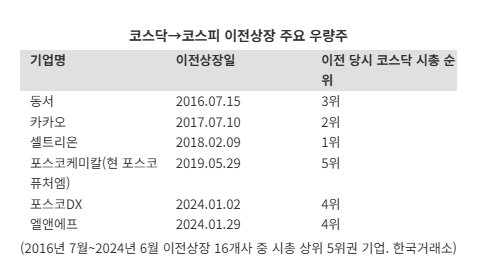
According to the financial investment industry on the 22nd, 16 companies transferred their listings from KOSDAQ to KOSPI between July 2016 and June 2024. Six of them—including Celltrion, Kakao Corp., Dong Suh, L&F, POSCO DX and POSCO Chemical (now POSCO Future M)—were among the top five KOSDAQ companies by market capitalization at the time of their transfer.
The companies that had represented KOSDAQ moved to KOSPI in response to demand for a reassessment of their corporate value and a broader investor base. Analysts say expectations of overcoming the undervaluation they faced simply because they were listed on KOSDAQ led to the transfers.
KOSDAQ’s tiered system, included in a plan to strengthen the capital market announced this past March, is intended to reduce such departures and boost the market’s competitiveness. The proposal would divide KOSDAQ into tiers such as Premium and Standard, while placing financially troubled companies in a separate management group. Companies would be promoted if they meet the requirements for entering a higher tier and downgraded if they fail to meet the requirements for remaining in their current tier. The detailed criteria could change during public consultation and the process of refining the system.
One proposal is to apply strict standards to the Premium tier in areas such as market capitalization, operating performance and corporate governance. The plan also includes introducing corporate governance reports and English-language disclosures, and developing an index centered on leading companies along with exchange-traded funds (ETFs) linked to it. The Standard tier would operate under the current KOSDAQ requirements, while expanding disclosures on performance outlooks and growth plans and making investor relations (IR) presentations a regular practice.
The key question is whether membership in the Premium tier alone can secure a level of credibility and investor demand comparable to transferring a listing to KOSPI. If the group of blue-chip companies becomes clearly defined and long-term investment flows in through related indexes and ETFs, companies may have a stronger incentive to remain on KOSDAQ. The system is also expected to motivate Standard-tier companies to improve their performance and corporate governance in order to move up.
The U.S. Nasdaq is divided into the Global Select Market, Global Market and Capital Market according to criteria including financial requirements. Analysts say that, like Nasdaq, KOSDAQ could develop into a market where growth companies can remain even after they mature: Nasdaq differentiates its markets according to company characteristics while still hosting large, high-quality technology companies. In April 2022, the Tokyo Stock Exchange reorganized its existing markets into three: Prime, Standard and Growth. Trading volume and value across the market have shown an upward trend since the reorganization.
Growth companies could be disadvantaged if the promotion and demotion criteria focus too heavily on current performance. Biotech and advanced technology companies may not have sufficient revenue or earnings in the early stages of their business, even if their future growth prospects are strong. If such companies are placed in a lower tier and become widely regarded as lower-quality companies, they could have difficulty attracting investment and raising funds.
Eom Su-jin, a researcher at Hanwha Investment & Securities Co., Ltd., said, “The positive effects of introducing the tiered system will outweigh its adverse effects,” adding, “A complementary measure that would better fulfill the purpose of the system would be to operate the management group separately while adding a group centered on promising emerging companies.”
[email protected] Choi Doo-seon Reporter