Homegrown AI chips hit the road as Gangneung tests them and explores export opportunities
- Input
- 2026-10-20 15:20:27
- Updated
- 2026-10-20 15:20:27
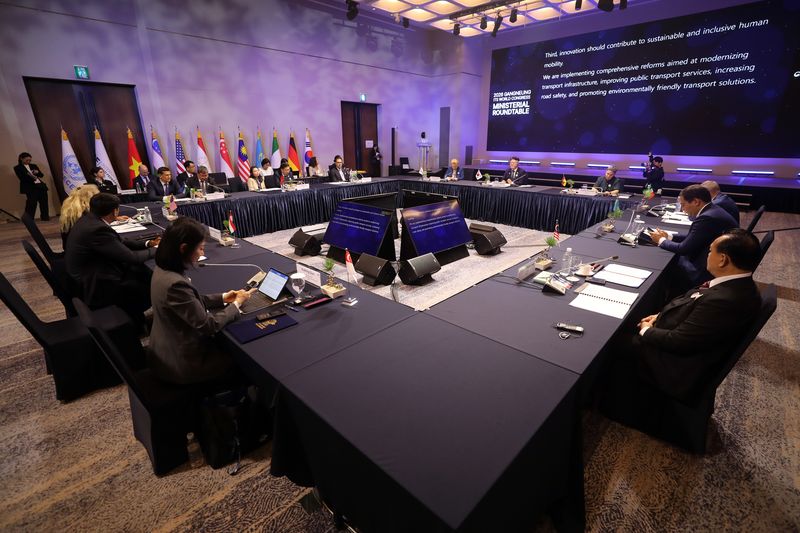
[Financial News] Homegrown artificial intelligence (AI) semiconductors are now facing a major test of their entry into the transportation market. Domestic neural processing unit (NPU) companies and intelligent transportation systems (ITS) firms are joining forces to test the potential of homegrown AI chips in real-world road settings, including smart intersections and traffic control. The plan is to broaden their cooperation from domestic field trials to commercialization and entry into overseas markets.
On the 20th, according to ITS Korea, the Korea Intelligent Transport Systems Association, a “K-NPU Transition Support Meetup for AI-ITS Innovation” will be held at the Gangneung Convention Center on the 22nd. Organized as part of the 2026 Gangneung ITS World Congress, the event will feature technology exchanges and business matchmaking between domestic NPU companies and ITS firms.
An NPU is a dedicated semiconductor designed to process AI computations efficiently. As the use of AI expands in traffic information analysis, smart intersections and road traffic management, power consumption, heat generation and operating costs—as well as computing performance—are emerging as key competitive factors.
Four domestic NPU companies will take part in the event: DEEPX, Mobilint, Rebellions and FuriosaAI. Participating in the ITS sector will be Mqnic, Space Insight, Baida, SOS Lab, Raonroad and Bambus, among others. KT, which operates AI services based on homegrown NPUs, will also attend.
The key aim is to determine whether homegrown NPUs can be deployed in real-world traffic settings. To switch AI models currently used in the transportation sector to domestic NPUs, companies need to verify compatibility with existing systems, optimize performance and ensure stability during long-term operation. In other words, field trials are needed in addition to securing technological competitiveness.
To that end, ITS firms will share examples of operating AI-based traffic services and their technology needs, and outline anticipated challenges in adopting homegrown NPUs. The four NPU companies will introduce the features and use cases of their respective products and explain their technical support plans, including providing software development kits (SDKs) and optimizing AI models.
In particular, in-depth presentations will cover the process of converting and optimizing AI models, as well as measurements of power consumption and heat generation before and after the transition. This will be followed by one-on-one business matchmaking between companies to discuss specific terms of cooperation, including dedicated engineering support and adoption costs.
ITS Korea plans to link the technology exchange to domestic field trials and commercialization, and to expand opportunities to participate in overseas ITS projects based on validated technology and operational experience.
Heo Cheong-hoe, chairman of ITS Korea, said, “As AI technology is used in a growing range of ITS services, including traffic information analysis and smart intersections, the performance and efficiency of NPUs are becoming increasingly important.” He added, “I hope this event will connect homegrown NPU technology with the needs of the ITS industry and serve as a stepping stone to field trials and commercialization in Korea’s transportation sector.”
He emphasized, “Building on technology and operational experience validated in Korea, we will expand technical cooperation, field trials and support for overseas expansion so that our companies can create new business opportunities in overseas ITS markets as well.”
[email protected] Kim Dong-ho Reporter