CSAT Setters Bicker, Actors Have Perfect Chemistry: The CSAT: The Secret Behind the Questions [This Film]
- Input
- 2026-10-21 09:33:49
- Updated
- 2026-10-21 09:33:49
[Financial News] “The CSAT is something the whole nation cares about. I thought that whatever subject matter we chose from our society, a cross-section of it would reveal many different facets.” (Director Lee Yong-jae)
On the 28th, 22 days before the College Scholastic Ability Test (CSAT) on November 19, the film “The CSAT: The Secret Behind the Questions” opens, offering a look into the world of adults who create the exam. Written and directed by Lee Yong-jae, it turns into a comedy a question almost everyone has wondered about at some point: “Who sets the CSAT questions, and how?”
“Write a Question with No Flaws” ... 40 Days of Turmoil at the Question-Setting Center
According to the Korea Institute for Curriculum and Evaluation, around 500 CSAT question setters and reviewers, along with some 230 people handling administrative work such as operations, meals and security—about 730 people in all—lived together for 38 days during the 2024 CSAT, held three years ago, through the fifth and final session on exam day. They handed in their mobile phones and other electronic devices, were restricted from going out, and could use the internet only to find materials needed to set the exam.
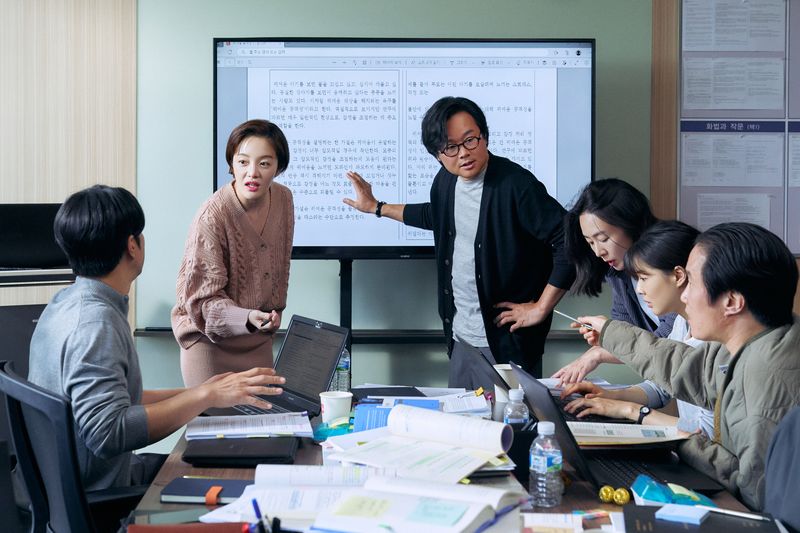
The film opens the door to the CSAT question-setting process, which people had heard about in news reports but did not really know much about. The fascination of getting a glimpse into this unfamiliar world is joined by the power struggles and tensions among the setters as they work to complete 45 questions. The process proves interesting, too, with far more discussion and review than one might expect. There is also the realization that, in the end, it is all done by people—and that workplace dynamics are part of it, too.
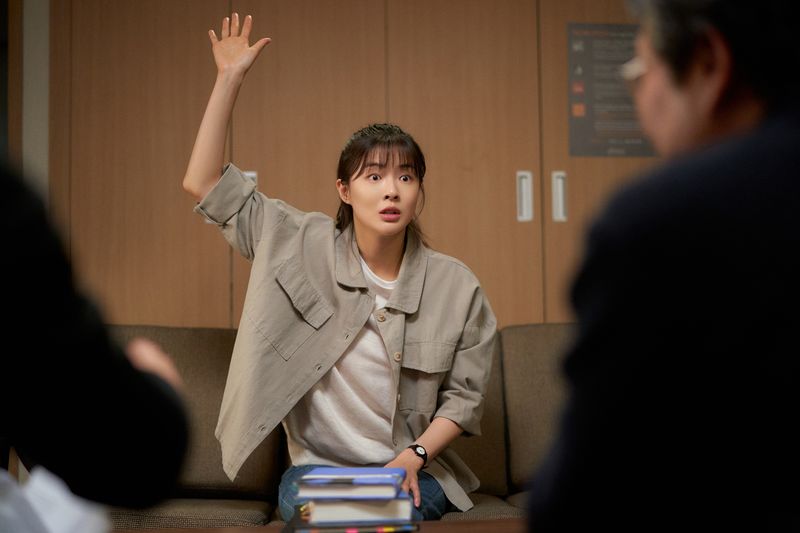
Maeng Bo-ram (played by Lee Sun-bin), a Korean-language teacher in a small provincial city, joins the CSAT question-setting center because of an administrative mix-up. After arriving, excited and full of anticipation, Maeng learns too late that they were summoned by mistake. By then, however, Maeng has already handed in their phone and been cut off from the outside world. Among the question setters, all graduates of prestigious universities and each with their own pride and interests, Maeng doggedly throws themself into creating “questions with no flaws”—with no typos or grounds for dispute.
Lee Sun-bin plays Maeng Bo-ram, a young teacher, while Yoo Jae-myung takes the role of committee chair Moon Ju-yeol, who pulls the strings at the question-setting center. Kim Young-min appears as Park Gyeong-tae, the review committee chair and Moon’s rival, and Jeon Seok-ho plays Ki Jun-su, an employee of the evaluation institute.
Parents with children facing entrance exams, however, may be left with complicated feelings after the laughter. It is hard to see the teachers who set the exams their children will take asserting their authority, fighting among themselves and sometimes looking for workarounds as someone else’s problem.
Yoo Jae-myung also had reservations before deciding to take the role. At a press screening on the 19th at CGV I’Park Mall in Seoul’s Yongsan District, he admitted that he had “thought about turning it down,” saying it pained him to portray an adult behaving unjustly. He also joked, “I have an image to maintain, too.” But he accepted the role because he felt that what happens at the question-setting center ultimately reflects a cross-section of our society.
Yoo described it as “a film that tries to tell, in an entertaining way, stories about all kinds of people fighting and compromising with one another, resorting to workarounds to protect their positions, and still living with sincerity amid it all.”
“I wanted to tell a story about good adults.”
Lee Yong-jae, who wrote the screenplay for “In Our Prime,” was also interested in exploring adults in this film. He said he was not especially focused on education itself; rather, he saw the school and the question-setting center as places where relationships between teachers and students, and adults and young people, come clearly into view. “As with ‘In Our Prime,’ I wanted to tell a story about good adults this time, too,” he explained.
The confined setting brings the characters’ personalities and relationships into sharper relief. The film’s appeal comes from the dialogue and natural rapport among actors with a range of distinctive personalities. Still, with little change in setting or circumstances, some of the tense exchanges feel repetitive. Asked about choosing a confined setting, Lee said that “practical considerations, including saving time and money as a first-time director, also played a part.”
Lee consulted a book titled “Who Sets the CSAT Questions, and How?” by a former professor who had served twice as an actual question setter. He also drew on question setters’ appearances on television and interviews with people he knew, but said, “When you fit a 40-day story into 99 minutes, a lot inevitably has to be omitted or exaggerated.” One major change was reducing the 30 to 40 Korean-language question setters in real life to 10 in the film.
Rather than meticulously recreate reality, the film focuses on conveying the overall atmosphere of the question-setting center and the people inside it. It also sought to capture the sincerity of the setters as they wrestle with how to create fair, high-quality questions.
The choice of comedy came from a hope that audiences would engage with the problems in our society without taking them too heavily. Lee described the film’s flavor as “closer to dark chocolate than milk chocolate.” He said, “I hope people can enjoy it, laugh without feeling weighed down, and then, after leaving the theater, get a slightly bittersweet taste as well.”
A line in the film says that each question costs several tens of millions of won. That amount is surprising, but it also makes you reflect on how much time and money our children invest in preparing for the CSAT from preschool onward. Beyond the issues of killer questions, the exam’s ability to distinguish among test-takers and fairness, you may also wonder whether the CSAT is really an appropriate system for nurturing the talent needed in the age of AI—especially given how many people and how much money go into it.
[email protected] Shin Jin-a Reporter