China’s EVs take the home market... but complete vehicles are left out of ‘Korea’s IRA’
- Input
- 2026-10-20 15:47:43
- Updated
- 2026-10-20 15:47:43

[Financial News] Imported EVs overtook domestic models in sales for the first time in September, and concern is mounting in South Korea’s automaking industry after the government excluded EVs from the domestic production tax credit, dubbed “Korea’s IRA.” As imported EVs from Tesla and BYD rapidly eat into the home market, domestic EVs are being held back by depleted purchase subsidies and sluggish sales. There are concerns that even as the EV market grows, the benefits could increasingly accrue to foreign companies.
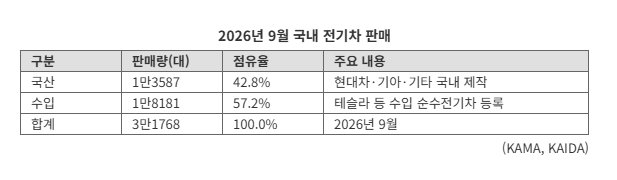
■Imported EVs overtake domestic models for the first time... Tesla and BYD capture 82%On the 20th, according to the Korea Automobile & Mobility Association (KAMA) and others, domestic EV sales totaled 31,768 in September. Imported EVs accounted for 18,181, or 57.2% of the total. Domestic EVs came to just 13,587 (42.8%), 4,594 fewer than imported vehicles. This is the first time monthly sales have reversed since KAMA began publishing domestic EV sales figures separately for domestic and imported vehicles this year.
Lee Sang-myeong, a Hanyang University business professor and president of the Automobile Industry Society, said, “It’s only one month’s figures, but it is by no means a signal to take lightly.” He called the push by Chinese EV makers, which have used their own discounts to make up for the subsidy gap, “a warning that cost-based competitiveness is real.” He stressed, “Our automakers need cost structures that can withstand the market without subsidies, and the government must move quickly on industrial policies to prepare for a flood of Chinese overproduction into the domestic market.”
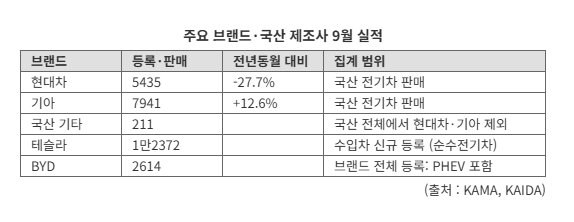
The imported EV market was effectively led by two brands. Tesla sold 12,372 vehicles and BYD 2,614, for a combined total of 14,986. That was 82.4% of all imported EVs in September. Tesla’s main models are the Model Y and Model 3, produced at its factory in Shanghai, China. The Model Y sold 11,421 units, ranking first among imported vehicles. Of those, 8,690 were Model Y L units.
BYD also ranked fourth among imported-car brands, selling 1,153 Dolphins, 745 Sealion 7s and 227 Atto 3s, among other models. Analysts say the price competitiveness of EVs made in China is reshaping the domestic market.
Kia Corporation sold 7,941 vehicles, led by 2,160 EV5s, 1,888 PV5s and 1,627 EV3s, posting growth of 12.6%. Hyundai, by contrast, sold 5,435, down 27.7%. Ioniq 5 sales fell 44.4% to 1,262, while the Ioniq 6 and Ioniq 9 also declined by 17% and 40.3%, respectively.
With EV purchase subsidies exhausted in some regions, imported brands lowered the price burden through their own incentives. Domestic sales from January to September this year totaled 167,312, compared with 132,582 imported vehicles, leaving domestic models ahead. But the monthly reversal exposed the gap in reliance on subsidies and cost competitiveness.
■‘Korea’s IRA’ leaves out incentives for domestic productionThe problem is that policy measures meant to support domestic production are out of step with changes in the market. The 2026 tax reform plan announced by the government on August 3 introduced a domestic production tax credit that reduces corporate taxes in proportion to the performance of companies producing and selling strategic items in South Korea, but excluded finished EVs. It covered only six areas: solar power, wind power, secondary batteries, semiconductors, core materials, and AI robot components.
The policy, which originated as a campaign pledge by President Lee Jae-myung, is dubbed “Korea’s IRA.” It is a different outcome from what the Ministry of Trade, Industry and Energy said at an event for Automobile Day in May—that it was discussing the introduction of a tax incentive for domestic EV production with relevant ministries. The government has also decided to gradually reduce the cap on the EV individual consumption tax reduction starting next year.
Purchase subsidies do not distinguish between production locations. Even when payments are tiered to reflect factors such as contributions to the domestic supply chain, vehicles made in China also qualify for support. National subsidies paid for purchases of key Chinese-made Tesla models in the first half of this year alone are estimated at around 114.6 billion won. By contrast, a production tax credit could directly incentivize domestic factory utilization, orders for parts suppliers and employment retention.
The government says support for batteries and cathode materials can also boost EV competitiveness. But lower battery costs do not directly translate into increased domestic production of finished vehicles. Critics say the entire supply chain, including motors, inverters and power semiconductors, must be considered. Fiscal costs, overlapping support and the possibility of trade friction remain challenges to be addressed.
Lee Ho-geun, a professor in the Department of Future Automotive Technology at Daeduk University, stressed, “If batteries alone are supported while finished vehicles are excluded from the support, there is a limit to how much the competitiveness of the industry as a whole can be improved.” He said, “There needs to be a system that sets clear conditions—such as domestic production, domestic parts sourcing, investment in research and development, and employment retention—and provides support based on the results.” He added, “A decline in finished-vehicle production also affects orders and employment at hundreds of suppliers,” and said the application of the domestic production tax credit to EVs should be reconsidered.
[email protected] Kim Dong-ho, Kim Dong-chan Reporter