“Should I sell, hold on or average down?” ... Helplessness as the KOSPI plunges 20% [The World of Retail Investors]
- Input
- 2026-10-20 20:00:00
- Updated
- 2026-10-20 20:00:00
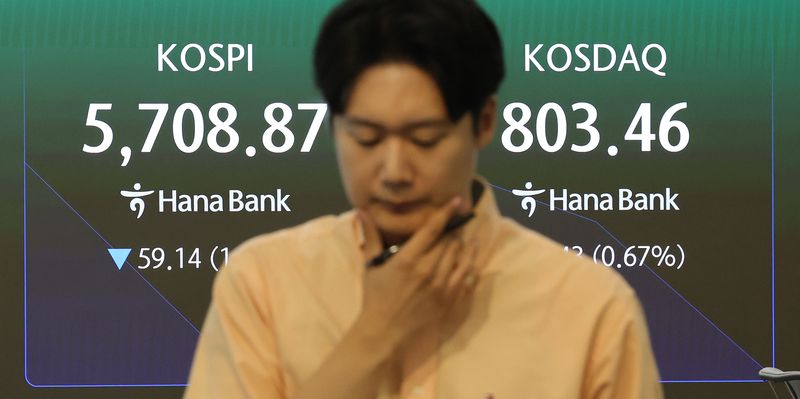
[Financial News] “After it had fallen this much, I thought it had hit bottom and bought more (made additional purchases), but I don’t know if I should buy even more.”A, a 37-year-old office worker, bought shares of Samsung Electronics and SK Hynix for their stock account in September. A said that as losses continued during the downturn that began in July, they decided to buy more, thinking they should at least try “averaging down.” But even into October, sharp drops kept recurring with no sign of a rebound, and A lost even the motivation to check the account.
A faced three choices: sell now to cut losses, hold on until a recovery, or buy more—even if it meant taking out a personal loan—to lower the average purchase price. On the morning of the 20th, as the KOSPI plunged more than 2% early in the session, A agonized over whether to sell or buy, but ultimately did nothing. “If I sell, it feels like the bottom, but buying more feels like pouring water into a bottomless pit, and I feel helpless,” A said.
21% wiped out in seven trading days... ‘Black October’
The KOSPI’s decline this month has been exceptionally rapid, with few precedents. According to Kiwoom Securities on the 16th, the KOSPIhad fallen for seven consecutive trading days, with cumulative losses reaching 20.8%The only steeper declines occurred duringthe 1997 Asian financial crisis (-25%), the 2008 global financial crisis (-31%), and the COVID-19 period (-25%).
Last week’s decline of 14.5% was the fifth-largest weekly drop since 1980, with a particularly steep plunge of 7.57% on the 15th alone. Through the 16th of this month, the KOSPI was down 17.1%, the biggest decline among major global indexes. On the 20th, it was down around 3% and traded around the 5,600 level before closing at 5,539.05.
Doubts about the profitability of the artificial intelligence (AI) industry and heavy foreign selling have been cited as factors behind the plunge. These were compounded by growing anxiety over unrest in France and rising U.S. Treasury yields, freezing investor sentiment. A string of earnings announcements from major companies such as Meta, Tesla and SpaceX beginning in the middle of this week also appears to have played a role.
As the sharp downturn continues, losses among individual investors are mounting. In particular, for those who have borrowed to invest, forced sales are surging after investors failed to meet collateral requirements, withthe value of forcibly liquidated shares in the 80-billion-won range for two consecutive daysamong the signs of a wave of forced selling.
Securities analysts: “Near the bottom” vs. “Don’t rush to buy”
Analysts are divided in their assessment of the steep market drop. Byun Jun-ho, a researcher at IBK Investment & Securities, said that “the disparity index had fallen to 83 on the 20th, while the 12-month forward price-to-book ratio (PBR) had dropped to 1.08” and that “it should be used as a bargain-buying opportunity targeting a rebound in November.”
Lee Jun-young, a researcher at Eugene Investment & Securities, also said, “The index is currently at the level of its July low, but 12-month forward earnings per share (EPS) have risen 12% from July, bringing the price-to-earnings ratio (PER) to 4.6, its lowest level in the past year. Pressure from credit-related supply and demand is beginning to ease, and valuation concerns are not substantial, so investors should consider buying.”
Caution is also widespread. Kim Dae-jun, a researcher at Korea Investment & Securities, said, “Although the KOSPI is in oversold territory, it is difficult to shift to aggressive net buying at this point,” and predicted that investors “should take a systematic, staggered approach to buying.”
Historical data also show that a “short-term rebound” is different from a “recovery in the trend.” According to Yuanta Securities, in 12 cases when the KOSPI plunged 10% or more over seven trading days, the probability of a gain over the following week was 83%. But among five cases where the decline exceeded 15%, the chance of a gain a month later was only 20%.
Lee Sang-yeon, a researcher at Shinyoung Securities Co., Ltd., also said, “At this point, there appears to be little benefit in selling into the decline, so I recommend holding on,” while advising, “For new purchases, it would be effective to wait until after seeing how the final week of October unfolds—with SK Hynix’s earnings and shareholder returns, big tech’s capital expenditure guidance for next year, and the Federal Open Market Committee (FOMC) all on the agenda—and then buy in stages.”
I don’t want to be a “shoulda” parrot, but once again today I’m thinking, “Should’ve bought, should’ve sold, should’ve held on...”Stocks, real estate, personal finance—it seems like everyone is doing just fine except me. No matter how much you study, the world of investing is difficult. To easily receive stories you’ll wholeheartedly relate to from[The World of Retail Investors]please subscribe to the reporter’s page.
[email protected] Kim Hee-seon Reporter