80 Years of Jeju as a Province, 20 Years as a Special Self-Governing Province... Residents’ Memories Become Public History
- Input
- 2026-10-20 15:13:52
- Updated
- 2026-10-20 15:13:52
【Financial News, Jeju = Reporter Jeong Yong-bok】 To mark 80 years since Jeju established its provincial system and 20 years since it became a special self-governing province, participants will discuss ways to document and preserve residents’ memories as local historical records. Experts from the United States, Taiwan, Canada and Ireland will share examples of citizen-participatory historical documentation and public history policy in Jeju.
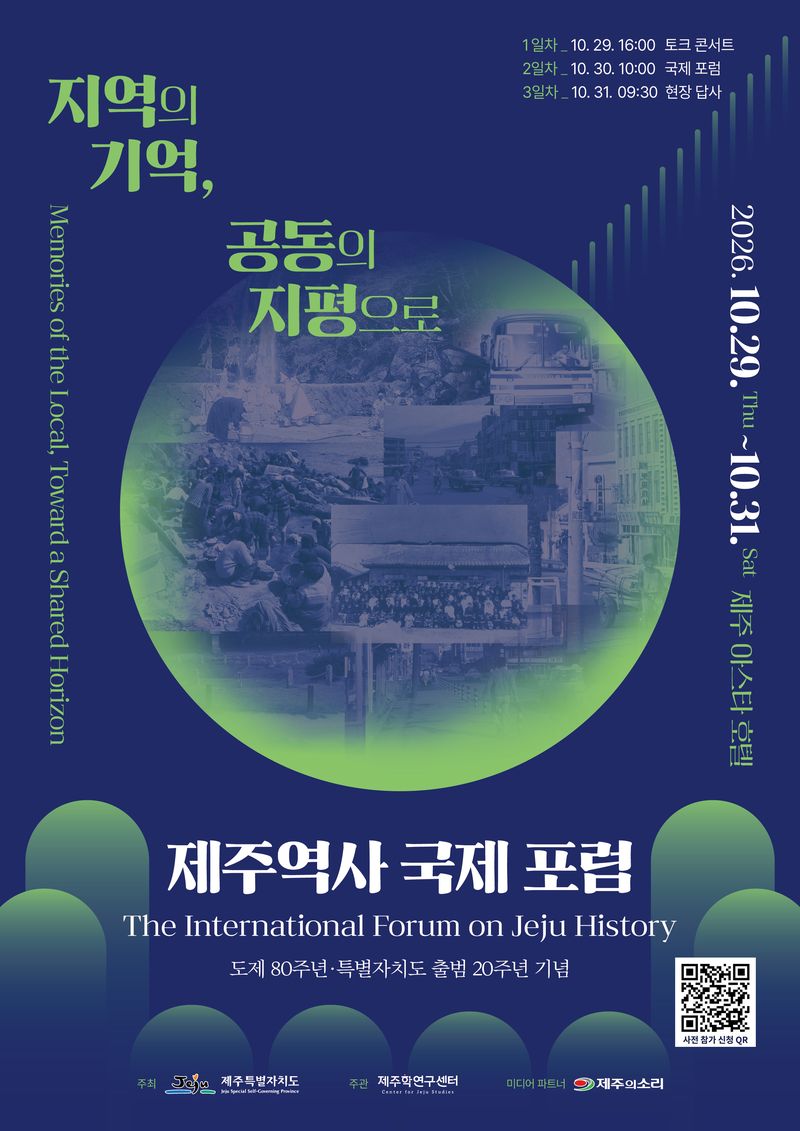
According to Jeju Special Self-Governing Province and the Jeju Studies Center on the 20th, the Jeju History International Forum will be held at Jeju Astar Hotel in Jeju City from the 29th to the 31st under the theme “Local Memories, Toward a Shared Horizon.” The event, hosted by Jeju Province and organized by the Jeju Studies Center, will bring together history and cultural heritage researchers from Korea and abroad.
This year marks 80 years since Jeju was separated from South Jeolla Province and established as a separate province. Jeju became a separate metropolitan administrative region when the provincial system took effect on August 1, 1946, and became a special self-governing province on July 1, 2006.
The forum will examine the significance of the two changes in administrative structure while also addressing how to preserve as historical records the changes in people’s lives as experienced by Jeju residents amid political and social upheaval and economic growth. Residents’ oral accounts and life histories, which are not captured in official documents and administrative records, will also be a key topic of discussion.
Following the opening ceremony at 4 p.m. on the first day, the 29th, a talk concert will be held under the theme “Time Asks, Jeju Answers.” Moderated by Kim Dong-hyeon, former chairman of the Jeju Federation of Artistic and Cultural Organizations, the event will feature Onpyeong-ri haenyeo Song Myeong-ja, Heo Gye-saeng, author of “Heo Gye-saeng, a Jeju Person,” and Go Ji-hun, owner of Usaengdang Bookstore, discussing changes in Jeju and their experiences of life.
An international academic forum will be held from 10 a.m. on the 30th. Kim Dong-jeon, a professor in the Department of History at Jeju National University, will deliver the keynote address on “The Trajectory of Jeju History Research and New Horizons.”
The academic forum will cover three areas: new approaches to local history, preservation of residents’ records, and public history policy. Seven researchers from Korea and abroad will present.
In the first session, Monica C. Labriola, an associate professor in the Department of History at the University of Hawaiʻi in the United States, will present a research approach to the history of the Pacific region that focuses on relationships among Indigenous communities. Zhang Rongzhi, former director of the National Museum of Taiwan History, will discuss ways to share local history with the public, drawing on the museum’s experience in Taiwan.
The second session will address ways to preserve residents’ experiences and oral records as historical materials. Tara Barrett, an intangible cultural heritage program planner at Heritage Newfoundland and Labrador in Canada, will explain the relationship between community documentation and living cultural heritage.
Una Brannagh, an associate professor at Dublin City University in Ireland, will present a case in which folklore materials collected in schools were developed into a digital public archive. Ireland’s public folklore archive platform, Duchas.ie, digitizes and makes available local stories and living cultural materials collected from residents by students in the 1930s.
The final session will discuss the institutions and organizations needed to support the documentation of local history. Chae Gyeong-jin, director of the Policy Research Office at the National Heritage Policy Research Institute, will present Seoul’s basic plan for a historic city, while Moon Gwang-gyun, a senior researcher at the Chungnam Institute of History and Culture, will present a case study of regional studies in Chungnam. Hong Bal-eum, a curator at the National Gaya History and Culture Center, will introduce examples of the development and operation of history and culture centers.
The sessions will be chaired by Shim Gyu-ho, president of the Jeju Association of Chinese Studies; Song Won-seop, a professor in the Department of Geography Education at Jeju National University; and Kang Man-saeng, chair of the Jeju History Establishment Committee.
An exhibition of photographs and archival materials documenting 80 years of change in Jeju will be held during the event. On the final day, the 31st, presenters from Korea and abroad are scheduled to visit the Jeju Haenyeo Museum and Jeju Stone Park to see sites where local history and cultural heritage are being preserved.
Anyone interested in Jeju history may attend the talk concert and international academic forum free of charge. Advance registration is available through the Jeju Studies Center.
“The changes in Jeju over the past 80 years are a history that all Jeju residents have written together, each from their own place,” said Kim Wan-byeong, director of the Jeju Studies Center. “I hope this forum will be an opportunity to bring those memories out, share them, and think together about how to preserve them.”
[email protected] Jeong Yong-bok Reporter