Japan to bring soil from a Martian moon to Earth in world-first attempt
- Input
- 2026-10-20 13:51:38
- Updated
- 2026-10-20 13:51:38
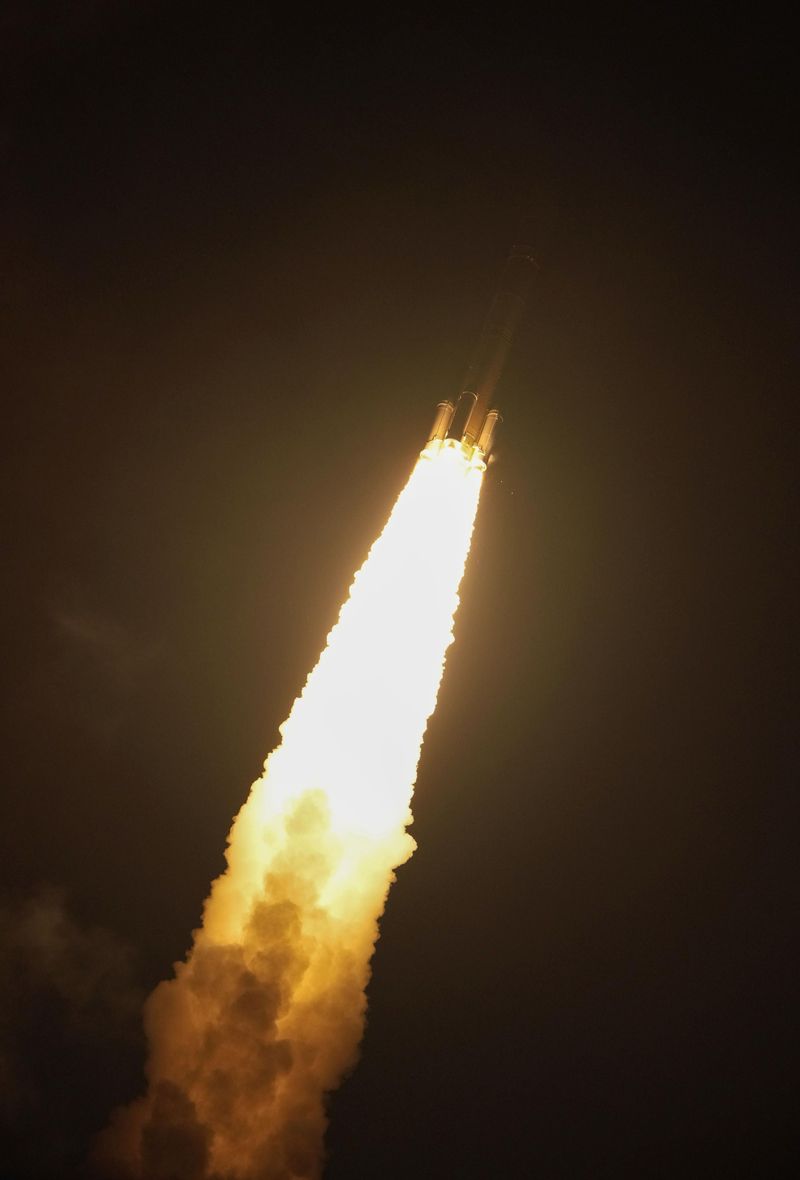
【The Financial News, Tokyo—Correspondent Seo Hye-jin】Japan has embarked on a space mission that will, for the first time in the world, bring soil from a Martian moon back to Earth. The plan is to apply sample-recovery technologies developed through the Hayabusa asteroid probe to Mars exploration and search for clues to the moon’s origins and signs of life. With the H3 rocket that carried the probe also successfully launched, the Japanese government is beginning talks to transfer launch operations to the private sector.
According to NHK and the Nihon Keizai Shimbun on the 20th, the Japan Aerospace Exploration Agency (JAXA) launched the 10th H3 rocket carrying the MMX probe from the Tanegashima Space Center in Kagoshima Prefecture at around 4:41 a.m. that day. About 1 hour and 11 minutes later, MMX separated from the rocket and entered an orbit bound for Mars. JAXA confirmed through ground communications that the probe was functioning normally.
■Tracing Mars’s past through Phobos’s soil
Developed at a cost of 55.3 billion yen (about 468.4 billion won), MMX is expected to arrive near Mars around next August. It plans to explore for about three years and land twice on Phobos, a moon of Mars. The goal is to collect at least 10 grams of soil from a depth of at least 2 centimeters below the surface and bring it back to Earth in fiscal 2031.
The first task in analyzing the samples will be to determine how Phobos formed. Two theories about its origins are in contention: that an asteroid was captured by Mars’s gravity, and that rocks ejected from Mars by a celestial collision gathered together to form the moon. A detailed analysis of the soil’s composition could provide clues to distinguish between the two hypotheses.
The mission is also expected to offer an opportunity to study Mars itself, independently of the question of Phobos’s origins. Material ejected when meteorites strike Mars is thought to have accumulated on nearby Phobos. According to a simulation by Hidenori Genda, a professor at the Institute of Science Tokyo, particles from Mars may account for roughly one in every 1,000 particles on Phobos’s surface. “There is a possibility that the samples MMX brings back will contain remnants or traces of microorganisms,” Genda said.
The key hurdle in obtaining samples is landing. Phobos’s gravity is about one two-thousandth of Earth’s, so the probe could bounce off or tip over from the impact of landing alone. The development team reduced this risk by incorporating shock-absorbing honeycomb structures into the probe’s four landing legs.
■H3 transfer to private sector pursued after successful launch
The H3 rocket that carried MMX into orbit has now completed eight successful launches out of 10. After postponing the transfer to the private sector following failures on its maiden launch and Flight 7, the Ministry of Education, Culture, Sports, Science and Technology and JAXA have decided, following a run of recent successful launches, to discuss terms with Mitsubishi Heavy Industries with a view to transferring operations next year.
Until now, Mitsubishi Heavy Industries has been responsible for manufacturing the rocket, while JAXA has handled launches. If Mitsubishi Heavy Industries takes on both tasks, it will be able to adjust launch schedules to meet customer timelines and buy components in bulk based on long-term orders, helping to reduce costs.
The move is intended to increase overseas orders. H2A, the predecessor to H3, had launch costs of about 10 billion yen per flight (about 84.7 billion won), and secured only five overseas orders. H3 aims to cut costs to about half that level. To compete with U.S. company SpaceX, which accounted for 165 of the world’s 316 rocket launches last year, securing price competitiveness is essential. After handing over launch operations, JAXA plans to focus its personnel on developing next-generation technologies, including reusable rockets.
Prime Minister Sanae Takaichi said on X that day, “I hope this historic challenge and the sample return from the Martian system will succeed.” She added, “I will strengthen technology development through the Space Strategy Fund and support for private-sector operators, and work to improve rocket performance, increase launch frequency, and enhance reliability.”
[email protected] Seo Hye-jin Reporter