Korea Expressway Corporation's non-stop toll collection technology to be used on Malaysian highways
- Input
- 2026-10-20 13:28:49
- Updated
- 2026-10-20 13:28:49
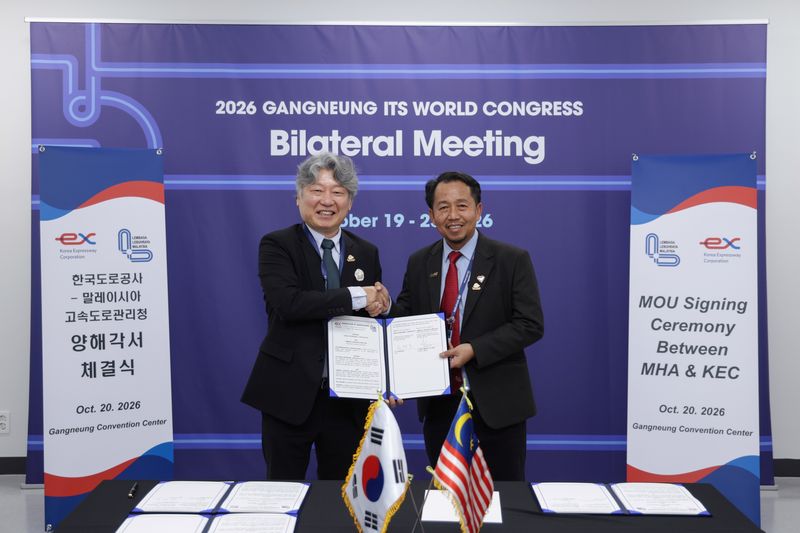
Korea Expressway Corporation said it signed a memorandum of understanding (MOU) with the Malaysian Highway Authority (LLM) on the 20th at the Gangneung Convention Center to cooperate in the road and transport sectors. The MOU gives concrete form to practical cooperation under an agreement reached by the two countries' governments last December. The MOU was signed on the occasion of the 2026 Gangneung ITS World Congress.
The Malaysian Highway Authority is an agency under the Ministry of Works. It is responsible for formulating policy on toll highways and managing and supervising private-sector operators.
Areas of cooperation include smart highway management and development, advanced tolling policies and systems, smart traffic management centers and intelligent transportation systems (ITS), highway infrastructure development and asset management, and technology transfer and training.
The key initiative is Malaysia's plan to introduce a multi-lane free-flow (MLFF) tolling system on toll highways nationwide. It allows drivers to pay tolls without stopping across multiple lanes and without physical lane dividers, and is similar to South Korea's multi-lane Hi-Pass electronic toll collection system. Korea Expressway Corporation plans to provide non-stop toll collection technology and operational experience for the project.
Following the nationwide rollout of the Hi-Pass electronic toll collection system in 2007, Korea Expressway Corporation introduced the 'One Tolling System,' which lets drivers use public and privately financed highways consecutively and pay their tolls in a single payment at the final exit, as well as multi-lane Hi-Pass. Currently, about 94% of highway users use Hi-Pass.
Overseas, the corporation operates a multi-lane free-flow tolling system on Kazakhstan's Almaty Ring Road. It has also built RFID-based electronic payment systems on Bangladesh's Padma Bridge and N8 highway, which wirelessly read vehicle tags.
Korea Expressway Corporation President Yoo Jeong-hun said, "I hope this agreement will strengthen trust between the two organizations and serve as an opportunity to develop a strategic partnership for building next-generation highways. We will work closely together so that our corporation's advanced technology and accumulated experience can contribute to Malaysia's smart highway projects."
[email protected] Choi Ga-young Reporter