‘Aricell case’: Four-year prison sentence for Aricell CEO Park Soon-kwan finalized; Supreme Court says CEO is the person responsible for management
- Input
- 2026-10-20 10:44:52
- Updated
- 2026-10-20 10:44:52
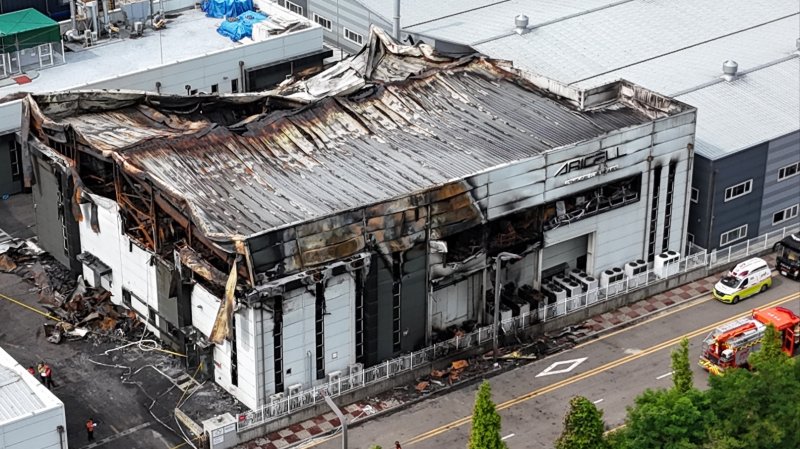
The Supreme Court’s First Division, with Justice Cheon Dae-yeop as the justice in charge, dismissed on the morning of the 20th all appeals filed by Park and others, including his son Park Jung-eon, Aricell’s head of general operations, who were indicted on charges including violating the Serious Accidents Punishment Act (causing death in an industrial accident). The prosecution’s appeal was also dismissed. Park’s four-year prison sentence, the head of general operations’ seven-year prison sentence and 1 million won fine, and an 800 million won fine for the corporation Aricell were finalized. Two executives received suspended sentences, and the acquittal of one senior member of the production management team was finalized.
The accident occurred on June 24, 2024, at a post-processing work area on the second floor of Building 3 at Aricell’s plant in Hwaseong, Gyeonggi Province. Lithium primary batteries stockpiled for work exploded and caught fire, due to internal short circuits and other causes, killing 23 people and injuring nine. Many of those killed were workers illegally dispatched by an unlicensed company.■ “If there is no safety and health officer, the CEO bears sole responsibility”The Supreme Court explained that the term “persons responsible for management, etc.” in Article 2, Subparagraph 9(a) of the Serious Accidents Punishment Act covers two roles: the person responsible for the business as a whole and the person responsible for safety and health work. Regardless of formal position or title, the person responsible for the business as a whole is someone who actually represents and oversees the business, has the authority and responsibility to manage it overall, and holds final decision-making authority over its organization, personnel and budget. The person responsible for safety and health work is someone delegated comparable authority and responsibility, who oversees all safety and health work and exercises final decision-making authority within the scope assigned to them.
The court ruled that “if there is no such person responsible for safety and health work, the person responsible for the business as a whole alone becomes the person responsible for management, etc., and the holder of the responsibilities and duties under the Serious Accidents Punishment Act.” It said that even when there is a person responsible for safety and health work, matters that must be decided from the perspective of overseeing management as a whole remain the responsibility of the person in charge of the business overall. These include setting the direction of the business and deciding its organization and structure, allocating budgets and personnel among departments, and appointing and evaluating the person responsible for safety and health work. The court also set out that both people would be liable if violations of their respective duties caused the serious accident.
There was no one at Aricell who qualified as a person responsible for safety and health work. The Supreme Court found no error in the lower court’s ruling that Park Jung-eon was neither the person responsible for the business as a whole nor the person responsible for safety and health work. That is why Park, the CEO, became the sole person responsible for management.■ Conducting a risk assessment does not by itself fulfill the dutyAnother issue was whether having a risk assessment procedure under Article 36 of the Occupational Safety and Health Act could be considered equivalent to establishing the work procedures for identifying and improving harmful and hazardous factors required under Article 4, Subparagraph 3 of the Enforcement Decree of the Serious Accidents Punishment Act. The Supreme Court held that the two procedures apply to different regulated parties, regulatory units and protected interests, and that the mere existence of a risk assessment procedure did not fulfill the duty to establish work procedures.
However, the court said that under the proviso to the Enforcement Decree, if an organization established risk assessment procedures, actually carried them out and received a report on the results, both the duty to establish work procedures and the duty to inspect should be deemed fulfilled. It clarified that neither duty is deemed fulfilled if even one requirement is missing, and that the duty to take action based on inspection results is not covered by this deeming provision. Aricell had risk assessment rules and plans, but they did not reflect the characteristics of a workplace handling lithium; moreover, it did not conduct assessments at all from 2023 onward, leaving no basis to deem the duties fulfilled.
With the dismissal of the prosecution’s appeal, the parts that the second-instance court had found not guilty were also finalized. The appeals court ruled that there was no duty to install an emergency exit on the second floor of Building 3, reasoning that the emergency-exit installation standard in the Occupational Safety and Health Regulations applies to “buildings” but does not expressly cover every floor. The acquittal on the charge of concealing an industrial accident was upheld on the grounds that the seized evidence had no objective connection to the alleged criminal facts specified in the search-and-seizure warrant and therefore constituted unlawfully obtained evidence.
[email protected] Kim Dong-gyu Reporter