Schools can now forcibly remove malicious complainants and report them to police
- Input
- 2026-10-20 12:51:35
- Updated
- 2026-10-20 12:51:35
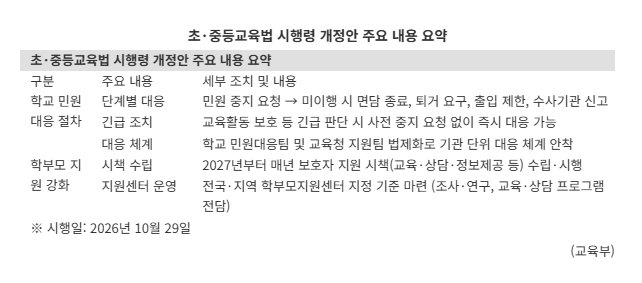
[Financial News] Going forward, if the conduct of a student or guardian filing a complaint at a school risks infringing on a teacher’s educational activities, the principal will be able to end a phone call or meeting and ask them to leave. In urgent cases, the principal may take immediate action without a prior warning.
The Ministry of Education said the State Council of South Korea deliberated on and approved the amendments to the Enforcement Decree of the Elementary and Secondary Education Act, which contain these provisions, on the 20th. The move follows the revised Elementary and Secondary Education Act, promulgated on April 28, taking effect on the 29th. The amendments spell out the detailed procedures that the law requires the enforcement decree to set. The decree will also take effect on the 29th.
■ If a request is ignored: end the meeting, removal, and restrictions on entry
The revised law stipulates that if the conduct of a parent or guardian, among others, while filing a complaint risks infringing on an educator’s educational activities or obstructing their work, the principal must take necessary measures, such as asking them to leave. The previous enforcement decree had no related provisions, but procedures for taking action have now been added. The measures apply to students and guardians filing complaints, among others.
The procedure has two steps. First, the principal must tell the complainant that their current behavior may constitute an infringement on educational activities or an obstruction of work, and ask them to stop. As a rule, this step must be taken before further action. Schools will respond to complaints under this procedure starting on the 29th.
If the complainant does not comply with the request, the principal may end the phone call or meeting. The principal may also ask them to leave the school or temporarily restrict their entry. Reporting the matter to an investigative agency is also an option. The principal may take these measures when they deem them necessary.
There is an exception. If the principal determines that immediate action is necessary to protect educators’ educational activities and ensure the normal operation of their work, these measures may be taken without first asking the person to stop. The principal decides whether the situation is urgent.
A school-level response system will also be established. The revised law explicitly provides for school complaint-response teams and school complaint-response support teams at agencies with jurisdiction over schools.
The Ministry of Education expects an institution-level complaint-response system to take root in schools once the law and enforcement decree come into effect. Education Minister Choi Kyo-jin said, “We will continue to provide support so that the institution-level school complaint-response system can take root smoothly in the field.”
■ Annual parent-support policies to be drawn up from 2027
Measures to support parents will also be introduced. Starting in 2027, the education minister and superintendents must formulate and implement support policies for guardians every year.
The policies will cover parent education and counseling, the provision of information, establishing cooperation between schools and Parent Support Centers, training professionals, and securing and allocating funding. Superintendents will formulate their policies in consideration of the education minister’s policy, while cities and provinces will set out the details in ordinances. When policies are established or amended, the education minister must notify the superintendents, and the superintendents must notify the principals of schools under their jurisdiction.
When formulating the policies, the Ministry of Education may, if necessary, gather the views of schools and parents and survey the status of support programs, staffing, and budgets.
Criteria have also been established for designating Parent Support Centers to back the policies. Public institutions, universities, universities of education, and other organizations may be designated as national or regional Parent Support Centers if they have the necessary organizational structure and staff, office space and equipment, project plans, and operating rules.
The national center will be responsible for research, policy analysis and evaluation, and running training courses for professionals. Regional centers will run parent education and counseling programs, provide information about relevant systems, and support communication among parents, schools, and education administrative agencies.
The Ministry of Education expects this to provide more substantive support for parents’ understanding of education policies and for communication. The education minister and superintendents may provide funding for center operations within their budgets.
[email protected] Kim Man-gi Reporter