VIRNECT launches Ministry of National Defense anti-drone AI simulator project, expands defense business
- Input
- 2026-10-20 10:21:29
- Updated
- 2026-10-20 10:21:29
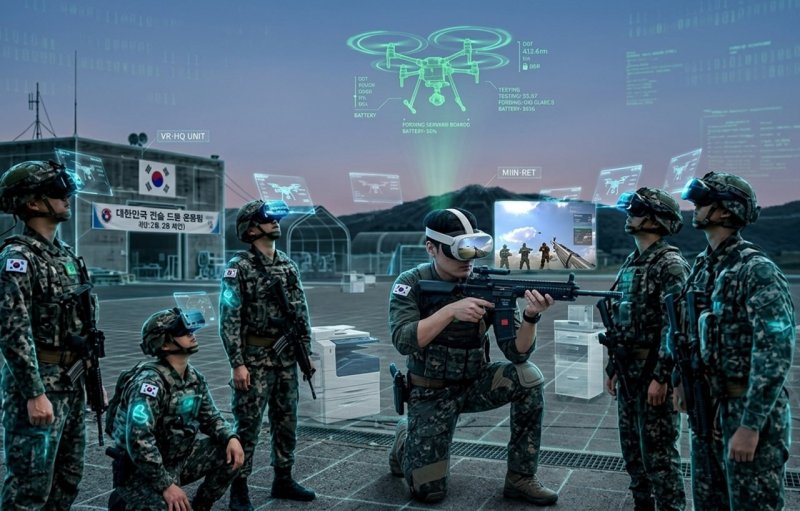
[Financial News] VIRNECT said on the 20th that it would launch the Ministry of National Defense’s project to develop an “artificial intelligence (AI)-based virtual reality (VR) and mixed reality (MR) anti-drone training simulator” and support its rapid commercialization.
The project will run as a consortium for 12 months, with total government funding of 2 billion won. Of that amount, 720 million won has been allocated to VIRNECT. The company plans to conduct demonstrations in actual military environments to verify whether AI-based anti-drone training and decision-making technologies can be applied in the field.
VIRNECT will be responsible for developing key technologies in the consortium, including reinforcement learning-based swarm AI and lightweight AI inference models. It plans to expand the scope of its technology applications into AI-based training and autonomous decision-making, drawing on the defense-sector technologies and business experience it has accumulated.
VIRNECT has recently expanded the use of AI and digital technologies in defense settings by successively carrying out the Army’s “AR- and AI-based Maintenance Support System Combat Experiment” and the Marine Corps’ “Real-Time Command and Remote Support Demonstration.” Through this project, the company plans to strengthen its defense business portfolio to include anti-drone training.
The project will use multi-agent reinforcement learning technology. VIRNECT plans to build a training environment where a swarm AI system, in which multiple drones change their attack patterns depending on the situation, can be used to repeatedly train against a range of attack scenarios resembling real-world situations.
It will also recreate various attack scenarios involving AI-controlled drone swarms in a virtual environment based on actual military facilities and training conditions. The company plans to provide training scenarios that are difficult to repeat in real-world settings and enable the verification of AI decision-making and responses during training.
VIRNECT will also develop a lightweight AI inference model of 500 MB or less. It plans to optimize the model for direct operation in edge environments, such as on-site PCs and equipment, without a separate server, reducing dependence on networks and creating an environment in which AI can make decisions and respond quickly according to training scenarios.
A VIRNECT official said, “This project will be an opportunity to combine reinforcement learning and AI technologies with the defense technologies we have accumulated, and develop them into AI-based training technologies that can be used in actual defense environments.” The official added, “Through military demonstrations and entry into the procurement market, we will build a track record in the defense sector and expand the areas of application to all branches of the armed forces, nationally important facilities, and overseas defense markets, fostering defense business as a new growth pillar.”
An industry official said, “For an anti-drone training simulator, what matters is how realistically it can recreate a range of threat scenarios and whether repeated training can improve response capabilities.” The official added, “If the implementation of swarm AI attack patterns and lightweight AI technology that can run on field equipment are validated in actual military environments, they will provide a basis for improving the utility of training systems.”
[email protected] Choi Doo-sun Reporter