“Strong earnings aren’t enough to keep them afloat” ... Samsung Electronics and SK Hynix falter as KOSPI and KOSDAQ fall together
- Input
- 2026-10-20 09:54:12
- Updated
- 2026-10-20 09:54:12
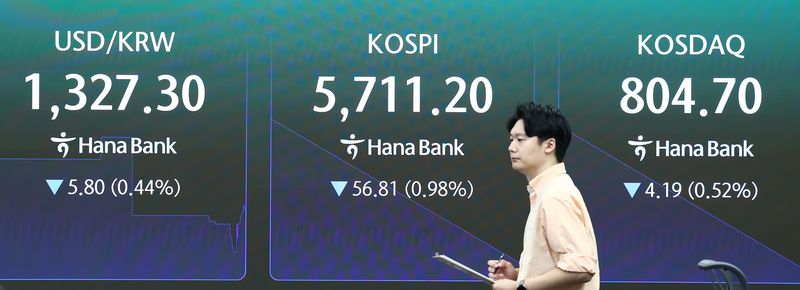
[Financial News] The KOSPI fell below the 5,600 mark intraday as Samsung Electronics and SK Hynix declined together. The view is that concerns about funding for AI investment and the sustainability of excess profits are weighing on share prices despite an improved outlook for semiconductor earnings. The KOSDAQ also fell more than 2%, slipping below 800.
As of 9:45 a.m. on the 20th, the KOSPI was trading at 5,601.03, down 166.98 points (2.89%) from the previous trading day. The index opened at 5,733.57, then extended its losses and fell as low as 5,555.95 intraday.
The domestic stock market’s semiconductor bellwethers, Samsung Electronics and SK Hynix, were both weak. At the same time, Samsung Electronics was trading at 214,000 won, down 1.83%. SK Hynix stood at 1,216,000 won, down 4.78%.
Neither stock managed to sustain a rebound after its recent sharp decline. Samsung Electronics plunged 10.56% on the 15th, then rose 3.33% and 3.71% on the 16th and 19th, respectively, before falling again today. SK Hynix likewise fell 12.76% on the 15th and then rose for two consecutive trading days, but turned weak again.
Market doubts about the sustainability of excess semiconductor profits are cited as a reason earnings expectations have failed to support share prices. Noh Dong-gil, a researcher at Shinhan Financial Investment, said, “The market is applying a greater discount to how long those profits can be earned than to the size of current earnings.”
From September 23 through the 19th, shares of Samsung Electronics and SK Hynix fell 23.6% and 31.4%, respectively, while their 12-month forward earnings per share (EPS) rose by 1.8% and 3.3%, respectively. Noh said that “most of the stock-price decline came from multiple contraction,” adding that “forward P/E ratios fell to as low as 3.4 times for Samsung Electronics and 2.9 times for SK Hynix.”
Anxiety over funding for AI investment has fueled concerns about the sustainability of these profits. Noh noted, “Even if AI demand grows, whether funding will be available to build data centers and buy graphics processing units (GPUs) and memory is seen as a separate issue.” He added, “Neocloud borrowing burdens and concerns about the investment returns of hyperscalers have fueled fears of delayed investment and lower semiconductor orders.”
The concern is that high profitability among memory makers could translate into higher investment costs for customers. He said, “High margins mean high investment costs for customers,” adding, “When customers assess the efficiency of capital expenditures, not only volumes but also prices become subject to renegotiation.”
However, the assessment is that these concerns have not yet been confirmed by a deterioration in real-economy indicators. Noh said, “What has been confirmed is an increase in credit risk,” adding, “Unlike the caution in credit markets, spot memory prices and earnings outlooks remain solid.”
Meanwhile, the broader market decline was also pronounced amid weakness in large-cap semiconductor stocks. The KOSPI large-cap index fell 3.01%, while the mid-cap and small-cap indices declined 2.08% and 1.46%, respectively. On the main board, 734 stocks fell, far outnumbering the 133 that rose.
The KOSDAQ index was at 788.41, down 20.48 points (2.53%) from the previous trading day. After opening at 805.37, it fell as low as 784.53 intraday.
[email protected] Choi Doo-seon Reporter