Seoul housing construction outlook tops 110; capital region returns to baseline
- Input
- 2026-10-20 11:00:00
- Updated
- 2026-10-20 11:00:00
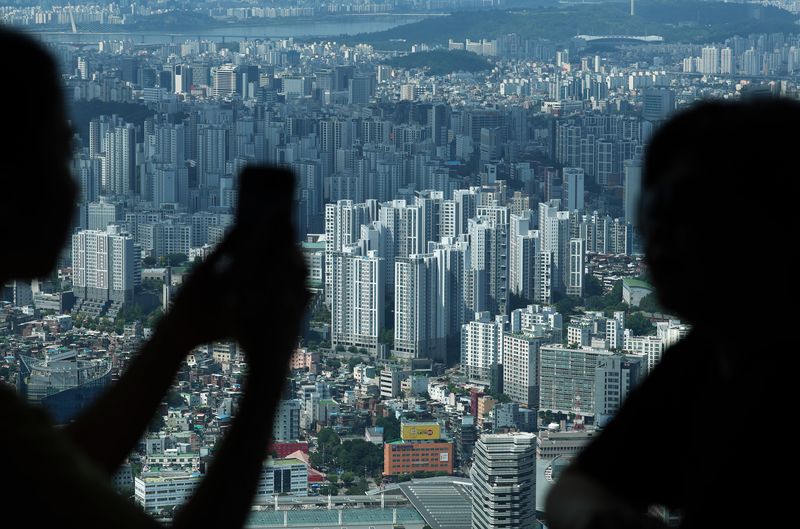
[Financial News] Business operators’ expectations for Seoul’s housing construction market climbed to 110.0 in a month. The outlook for the capital region as a whole also topped the baseline at 100.2, while the nationwide index rebounded to 86.4. Expectations of expanded PF guarantees and a decline in the exchange rate combined to improve the outlook for financing and materials supply.
According to the Housing Industry Research Institute on the 20th, a survey of member companies of the Korea Housing Association and the Korea Housing Builders Association, conducted from Sept. 17 to 29, found that the nationwide Housing Business Outlook Index for October rose 6.5 points from September’s 79.9. The capital region’s index jumped 11.0 points. The non-capital region’s index rose 5.5 points to 83.4. A reading above 100 means more businesses have a positive outlook for market conditions.
The October financing index and materials supply index rose 5.4 points and 6.4 points, respectively, from the previous month, to 80.8 and 95.1. The institute said expectations of benefiting from financial support measures were reflected in the financing outlook as specific follow-up steps emerged, including expanded PF guarantees and reduced guarantee fees under Korea’s Aug. 13 Housing Plan. It said the support measures had eased businesses’ concerns about their finances, despite rising interest rates increasing their interest burden.
The rise in the materials supply index was attributed to expectations that the recent decline in the won-dollar exchange rate would ease the cost of importing materials. However, international oil prices are fluctuating amid concerns that the war in the Middle East could drag on, and the exchange rate’s direction remains uncertain. The burden of raw material import prices and transportation costs has yet to ease.
Within the capital region, Seoul led the rise, gaining 12.8 points from 97.2. Incheon (79.3→90.6) and Gyeonggi (91.1→100.0) also rose by 11.3 points and 8.9 points, respectively. The institute said the index had jumped sharply as home prices continued to rise in Seoul’s outer areas and Gyeonggi, while expectations grew that business conditions would improve. There are also regional differences within Seoul. Transactions have declined in the three Gangnam districts and some parts of the Han River Belt, but prices continue to rise in mid- to lower-priced areas as buyer demand holds firm. In Incheon, expectations that strength in the Seoul and Gyeonggi markets would spill over had a positive effect, the institute said. Conditions have also improved for redevelopment and reconstruction projects. The order indices for both redevelopment and reconstruction stood at 105.0, up 11.9 points and 12.1 points, respectively.
The outlook also improved in most provincial regions. Ulsan posted the largest increase, jumping 32.1 points from 75.0 to 107.1. Busan followed, rising 26.2 points from 64.7 to 90.9. North Chungcheong (62.5→80.0) gained 17.5 points, and Daejeon (81.2→94.7) rose 13.5 points. South Chungcheong (8.8 points), Gwangju (6.3 points), Jeju (4.7 points), Daegu (1.6 points) and North Gyeongsang (1.5 points) also rose. By contrast, Gangwon fell 12.6 points from 81.8 to 69.2. South Gyeongsang (down 9.6 points), Sejong (down 6.7 points) and South Jeolla (down 6.6 points) also declined, while North Jeolla was unchanged from September at 75.0.
[email protected] Jeong Gyeong-su Reporter