“KOSPI plunges 17.11%” ... Worst among major global stock markets in October
- Input
- 2026-10-20 09:51:50
- Updated
- 2026-10-20 09:51:50
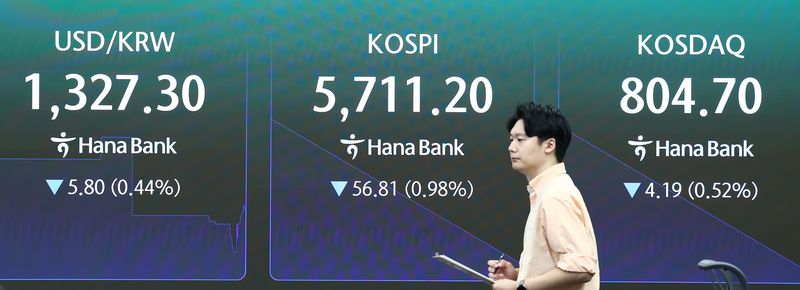
[Financial News] The KOSPI has plunged more than 17% so far this month, recording the lowest return among major stock markets worldwide. The decline is attributed to mounting concerns about the growth prospects of the artificial intelligence (AI) industry, compounded by heavy selling by foreign investors.
The KOSDAQ also ranked near the bottom in comparisons of returns among major stock markets. In South Korea, share prices fell for about seven out of every 10 listed companies.
According to the Korea Exchange and financial information service provider Yonhap Infomax on the 19th, the KOSPI’s return from the 1st through the 16th of this month was -17.11%, the worst performance among major stock indices worldwide.
The index with the next-largest decline after the KOSPI was Indonesia’s IDX Composite, which fell 14.59%. China’s Shenzhen Composite Index fell 7.40%, while the KOSDAQ declined 7.14%.
By contrast, Brazil’s Bovespa Index rose 10.24%, the highest return among major stock markets. Russia’s RTS Index also gained 7.17%, while Switzerland’s SMI rose 4.06% and India’s Sensex gained 3.10%.
Unlike the stock markets of some emerging economies, including Brazil, Russia and India, which rose, Asian markets—with their large semiconductor industry exposure—underperformed. Taiwan’s Weighted Index fell 1.73%, and Japan’s Nikkei 225 declined 2.14%.
Until early this year, the KOSPI had performed strongly compared with major stock markets. Except for March, just after the war between the United States and Iran began, and July, when it plunged amid a correction in global semiconductor stocks, it ranked among the top markets for monthly returns in most months.
Last April in particular, it surged 30.61% over the course of the month.
However, after the KOSPI fell 22.19% and the KOSDAQ declined 21.44% last July, gains in South Korea’s stock market narrowed sharply.
The KOSPI rose 3.40% in August, but its gain was just 0.26% in September. It then fell more than 17% again in October.
In year-to-date returns, too, the KOSPI lagged behind the stock markets of Taiwan and Poland. As of the 16th, Taiwan’s Weighted Index had gained 62.66% this year, the largest increase.
Poland’s WIG Index rose 36.66%, while the KOSPI’s gain was limited to 34.50%.
Concerns about the AI industry’s growth potential and investment returns weighed on South Korea’s stock market. As was the case last July, expectations for increased AI investment and rising semiconductor demand weakened, sending shares of major chipmakers such as Samsung Electronics and SK hynix sharply lower.
Heavy net selling by foreign investors also contributed to the decline in the indices. Beginning on the 2nd, foreign investors were net sellers on the main board for eight consecutive trading days. Their net sales over that period totaled 18.1308 trillion won.
The declines spread beyond Samsung Electronics and SK hynix to the broader domestic stock market. By the 16th of this month, 1,899 of the 2,760 companies listed on the KOSPI and KOSDAQ had fallen. That was 68.80% of the total—share prices declined at about seven out of every 10 companies, potentially resulting in losses.
By market, the number of declining stocks was 652 on the KOSPI and 1,247 on the KOSDAQ. A considerable number of listed stocks recorded declines approaching double digits.
So far this month, 1,120 stocks, or 40.58% of the total, have fallen by at least 5%. Another 588 stocks (21.30%) have dropped by at least 10%, while 127 (4.60%) have plunged by at least 20%.
Samsung Electronics, a major semiconductor stock, fell 19.74%, while SK hynix declined 28.38%.
Among individual stocks, KOSDAQ-listed Bigwave Robotics recorded the steepest decline. Its share price has plunged 61.60% so far this month.
By contrast, a total of 727 stocks rose over the same period: 254 on the KOSPI and 473 on the KOSDAQ. They accounted for 26.34% of all listed stocks.
[email protected] Han Seung-gon Reporter