Deepnoid expands medical AI beyond chest and brain imaging to cancer diagnosis
- Input
- 2026-10-20 09:05:49
- Updated
- 2026-10-20 09:05:49
[Financial News] Medical AI company Deepnoid is expanding its technological focus beyond chest and brain image interpretation into cancer diagnosis and digital pathology. By extending its existing image analysis technology to gene mutation prediction and testing processes, the company appears to be laying the groundwork for diversifying its product portfolio.
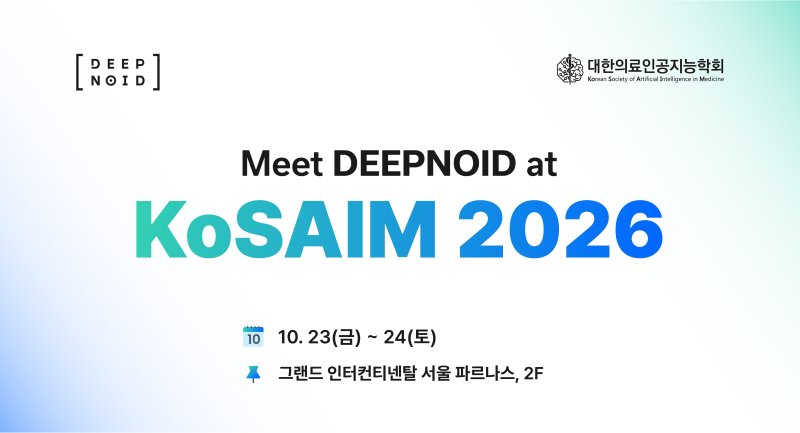
According to Deepnoid on the 20th, seven research abstracts were accepted for the Korean Society of Medical Artificial Intelligence’s regular academic conference, “KoSAIM 2026,” which will run for two days starting on the 23rd. The studies span chest imaging, brain magnetic resonance imaging (MRI), digital pathology and cytopathology.
The cancer diagnosis technologies are particularly noteworthy. Deepnoid will present research on predicting microsatellite instability (MSI), a biomarker related to immunotherapy for colorectal and gastric cancers, using only routine tissue slides. It will also showcase technology that predicts BRAF gene mutations from thyroid cytology images and determines malignancy in bladder cancer through urine cytology.
In chest imaging, the company will present “GLINT,” a vision-language AI technology that links radiology reports with medical images. The technology can identify abnormal findings and their locations without separately annotated lesion-location data, and could be used to improve the performance of existing chest imaging interpretation solutions. In the brain MRI field, Deepnoid will present research aimed at advancing image analysis technology for neurodegenerative diseases.
The medical AI industry expects technological competitiveness to depend on how broadly a technology can be applied in actual diagnostic processes, beyond simple interpretation accuracy. In particular, whether research results lead to adoption by medical institutions and new revenue is seen as key to future business competitiveness.
Deepnoid CEO Choi Woo-sik said, “We will connect our research achievements to product enhancements and services that support the entire interpretation workflow, and develop into a medical services company based on agentic AI.”
A medical AI industry official also added, “Competition in the medical AI market is expanding beyond basic image interpretation to encompass diagnosis and the entire testing process,” and said, “Whether existing image analysis technology can be extended to pathology and gene mutation prediction will be a factor determining future business competitiveness.”
[email protected] Kim Gyeong-a Reporter