Hyundai Motor's 'Level 4 trucks' to run up to 400 km as logistics commercialization gets underway
- Input
- 2026-10-20 08:56:09
- Updated
- 2026-10-20 08:56:09
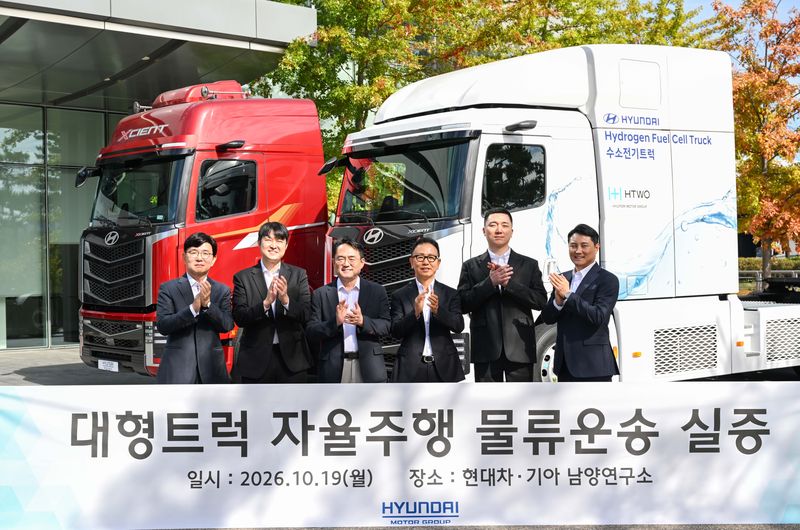
[Financial News] Hyundai Motor and Kia will deploy Level 4 autonomous heavy-duty trucks on real-world logistics routes of up to 400 km. Using two Xcient trucks, including a hydrogen fuel-cell truck, they will validate vehicle control technology and operational safety. The strategy is to expand pilot projects beyond autonomous city buses to freight transport and secure the key technologies and data needed for commercialization.
Hyundai Motor and Kia said on the 20th that they had signed an MOU with Hyundai Mobis, Hyundai Glovis, Mars Auto and RideFlux at the Namyang R&D Center in Hwaseong, Gyeonggi Province, for a pilot project involving Level 4 autonomous truck logistics transportation.
The core of the pilot project is to deploy autonomous heavy-duty trucks on real-world logistics routes operated by Hyundai Motor Group and validate how well vehicle control technology works in coordination with autonomous driving systems. Level 4 is a stage of autonomous driving in which a vehicle can drive itself without driver intervention under specified operating conditions and within designated areas.
Hyundai Motor and Kia plan to develop two vehicles for the pilot project—one Hyundai Xcient hydrogen fuel-cell truck and one conventional Hyundai Xcient truck—and provide them early next year. Each vehicle will be equipped with a customized controller and vehicle interface that can connect to external autonomous driving systems.
The full-scale pilot will run on two routes through the end of next year: an approximately 100-km route combining highways and urban roads, and an approximately 400-km long-distance route focused on highways. The companies plan to test the stability of the autonomous driving technology and transport efficiency across varied driving conditions spanning urban roads and highways.
Domestic autonomous driving software companies Mars Auto and RideFlux will each install their systems in specialized vehicles. Hyundai Mobis and Hyundai Glovis will support pilot operations using existing logistics routes. Hyundai Motor and Kia plan to develop vehicle control technology that can accommodate a range of autonomous driving systems by pursuing in-house advanced development alongside collaboration with external specialists.
In particular, they will use data gathered during the pilot to advance vehicle control and safety redundancy technologies. Safety redundancy is technology that allows a backup system to take over a function and keep the vehicle safe even if part of the system malfunctions. It is considered essential to commercializing autonomous driving for heavy-duty trucks, which frequently travel long distances and operate at night.
“Autonomous trucks are a key future mobility solution that can improve the safety and efficiency of logistics transportation,” said Park Sang-hyun, Hyundai Motor and Kia vice president in charge of Commercial LCM. “Through this collaboration, we will secure vehicle control technology and operational data needed in real-world logistics environments, and gradually build the technological foundation for commercializing Level 4 autonomous heavy-duty trucks.”
Meanwhile, on the 1st, Hyundai Motor and Kia signed an MOU with the Seoul Metropolitan Government to commercialize Level 4 autonomous city buses and build an industry ecosystem. After developing city-bus-specific vehicles and a fleet management platform, the companies are also pursuing logistics transport trials with heavy-duty trucks, expanding the scope of their autonomous driving business for commercial vehicles.
[email protected] Kim Dong-ho Reporter