Women in Their 40s Averaged 5,541 Steps a Day—1,200 Fewer Than Women in Their 70s
- Input
- 2026-10-20 08:35:17
- Updated
- 2026-10-20 08:35:17
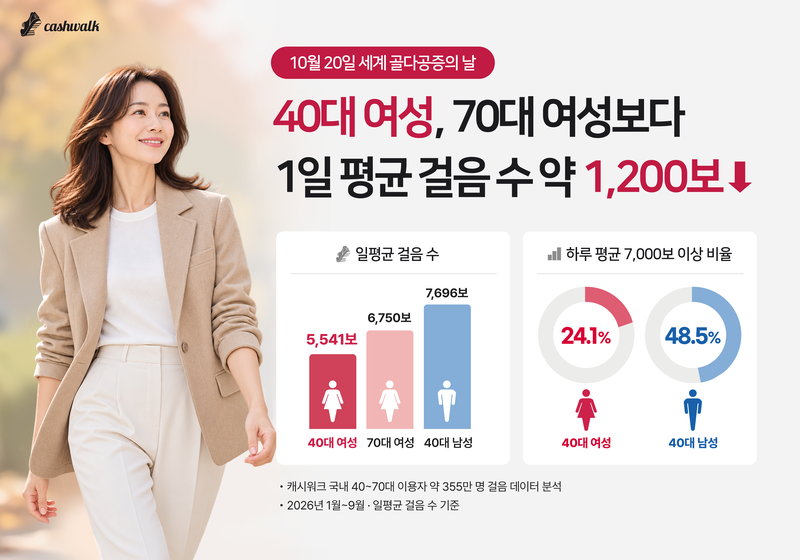
On the 20th, Nudge Healthcare analyzed step data from 3,550,264 users of its health management app CashWalk to mark World Osteoporosis Day. The analysis found that women in their 40s averaged 5,541 steps a day—the lowest figure among the eight groups of men and women in their 40s through 70s included in the study.
The analysis covered CashWalk users in South Korea who had step records from January through September this year.
Women’s average daily step counts rose with age: 6,094 in their 50s, 6,674 in their 60s and 6,750 in their 70s. Women in their 40s walked an average of 1,209 fewer steps a day than women in their 70s. The gap was also substantial compared with men in the same age group. Men in their 40s averaged 7,696 steps a day, 2,155 more than women.
A similar pattern emerged in the share of people who walked at least 7,000 steps a day on average. Among women in their 40s, the figure was 24.1%, about half the rate for men of the same age (48.5%). For women, the share increased with age, from 32.2% in their 50s to 40.5% in their 60s and 41.5% in their 70s.
These findings are significant because middle-aged women were relatively less physically active at a time when bone health is especially important. Bone density can decline rapidly in women around menopause, making it important to establish exercise habits before entering old age. However, step counts alone cannot determine overall physical activity or bone density.
Previous research has also confirmed the health benefits of walking. A meta-analysis published last year in the international journal The Lancet Public Health found that people who walked 7,000 steps a day had a 47% lower risk of death than those who walked 2,000.
However, walking alone has limitations as a way to maintain bone health. The International Osteoporosis Foundation (IOF) recommends exercising three to four times a week for 30 to 40 minutes per session to support bone and muscle health. This means combining weight-bearing exercise, such as walking, with strength and resistance training.
Jeong Seung-eun, a family medicine specialist and advisory committee member at Nudge Healthcare, said, “While step counts alone cannot determine the state of someone’s bone health, it is worth noting that this analysis found relatively low step counts among women in their 40s. Because bone loss accelerates starting about a year before a woman’s final menstrual period, it is important to combine strength training suited to one’s health with balance exercises to prevent falls, beginning before menopause.”
Jeong added, “Walking is a weight-bearing exercise that is easy to fit into daily life, but walking alone has limitations when it comes to maintaining bone density. People should keep walking regularly at a pace suited to their fitness and health, while also doing strength and balance exercises.”
The analysis was based on step records from CashWalk users and does not represent physical activity levels across the entire population. Steps taken when users were not carrying their smartphones were not counted, so the recorded totals may differ from their actual step counts.
[email protected] Jeong Sang-hui Reporter