Nighttime wildfire-fighting drones and construction-site flagger robots get the green light for field trials
- Input
- 2026-10-20 11:00:00
- Updated
- 2026-10-20 11:00:00
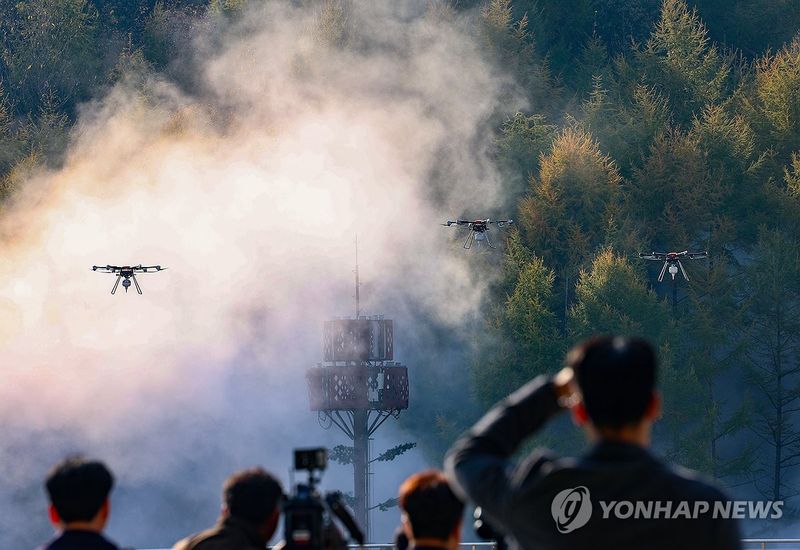
[Financial News] A drone carrying a water bag will be deployed at a wildfire site in the middle of the night, when helicopters cannot take off. On highway construction sections, autonomous robots will enter traffic lanes and direct vehicles with hand signals in place of people. The government is granting regulatory exemptions to 13 new technologies, including these, in disaster response and traffic safety, allowing them to proceed to field trials.
According to the Ministry of Land, Infrastructure and Transport on the 20th, the ministry placed 13 new technologies and services seeking field trials on the agenda of the 9th Mobility Innovation Committee meeting and approved regulatory exemptions for them. Also known as a regulatory sandbox, a regulatory exemption is a system that allows technologies and services previously blocked from launch by existing laws and regulations to be tested in the market first. Exemption recipients can conduct field trials for up to four years: an initial two years, with a possible two-year extension. If their safety and effectiveness are confirmed during this period, the relevant laws and regulations will be revised and they will transition to full-scale services.
In the area of road construction-site safety, an “autonomous mobile flagger robot” received an exemption. Workers at highway construction sites are easily exposed to accidents because vehicles pass at high speeds. The risks were even greater before safety facilities were in place, when patrol personnel had to walk directly into traffic lanes and use hand signals and other measures to prevent accidents. The Ministry of Land, Infrastructure and Transport granted an exemption from road traffic laws and regulations so that mobile robots equipped with autonomous-driving technology can enter highway construction sites and similar locations in place of people. Once commercialized, the robots are expected to reduce casualties and replace workers assigned to dangerous tasks.
In the wildfire sector, a nighttime, beyond-visual-line-of-sight firefighting service was selected for field trials. Helicopters, the mainstay of wildfire suppression, are often grounded after dark because visibility is poor, causing responders to miss the golden window for initial suppression. Drone applications are expanding, but flights that drop or release objects, nighttime flights, flights beyond the pilot’s visual line of sight, and swarm operations involving multiple drones have so far been permitted only on a limited basis due to safety concerns. Under this exemption, drones carrying water bags can be deployed at wildfire sites at night where helicopters cannot operate, helping prevent the flames from spreading. The ministry also expects drones to complement the existing firefighting system, which relies primarily on helicopters.
Capacity for aerial firefighting at night remains limited. Of the Korea Forest Service’s 50 firefighting helicopters, only eight are reportedly equipped with night-vision gear and able to be deployed after dark. Even these can take off only when all required weather conditions—including wind speed, visibility and cloud ceiling—are met. Embers left beneath the layer of fallen leaves overnight could reignite the next day and develop into a major fire, making it a longstanding challenge to fill the gap in nighttime response.
A wide range of everyday mobility services also received exemptions. Field trials are beginning in the traffic safety and eco-friendly sectors for variable rear underride guards and plug-in hydrogen hybrid buses. A variable rear underride guard is designed to reduce damage from “underride” crashes, in which a vehicle behind a truck slides underneath it. Plug-in hydrogen hybrid buses use both hydrogen fuel cells and batteries. In tailored transportation, demand-responsive transit (DRT) buses will begin operating to connect the daily activity areas of students commuting to and from school and people in vulnerable circumstances. Also included in the field trials are a service that lends replacement vehicles when freight or delivery trucks are immobilized in accidents, and a shared platform for putting idle vehicles parked in residential complexes to shared use.
Park Jun-hyeong, director general of the Mobility and Automotive Bureau at the Ministry of Land, Infrastructure and Transport, said, “These exemptions focus on advanced disaster-response technologies and mobility services closely tied to everyday life that people can experience firsthand.” He added, “We will make safety management our top priority during field trials and continue working to ensure that validated technologies are quickly incorporated into the regulatory framework.”
[email protected] Jeong Gyeong-su Reporter