Supreme Court to rule today in 'Aricell fire' that killed 23; duty to provide emergency exits at issue
- Input
- 2026-10-20 08:01:46
- Updated
- 2026-10-20 08:01:46
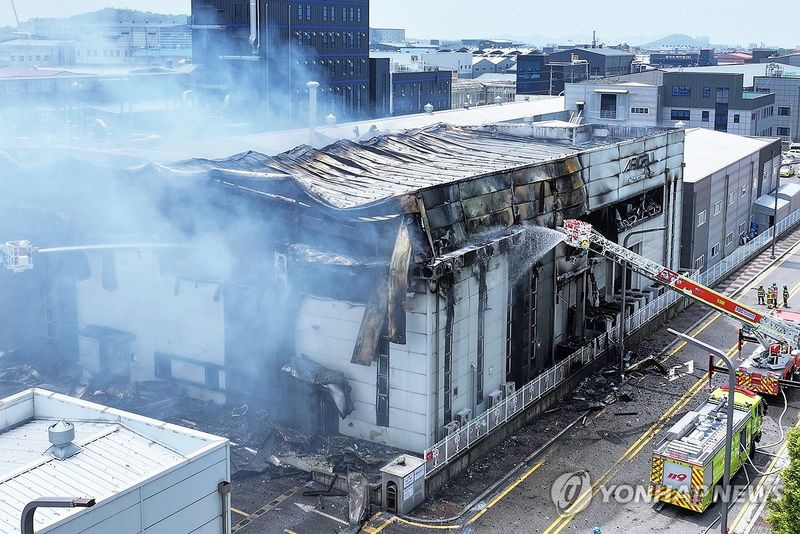
According to legal sources, the Supreme Court of Korea's First Division, with Justice Cheon Dae-yeop as the justice in charge, will issue its ruling at 10 a.m. today in Courtroom No. 2 of the Supreme Court of Korea in Seoul's Seocho District in the appeal involving Park, his son and general manager Park Jung-eon, three Aricell executives and employees, and the corporation Aricell. They were indicted on charges of violating the Serious Accidents Punishment Act (occupational accident resulting in death), the Act on the Protection, etc. of Temporary Agency Workers, and the Occupational Safety and Health Act. A decision is also expected the same day on the application filed by Park and the corporation to refer the laws for constitutional review.
The accident occurred on June 24, 2024, on the second floor of Building 3 at the Aricell factory in Hwaseong, Gyeonggi Province. An explosion and fire broke out in lithium primary batteries stacked for post-processing work, due to an internal short circuit and other causes, killing 23 people and injuring nine. The main entrance on the first floor leading to the stairs was adjacent to the initial ignition point, while another door leading to the stairs via the research institute and research equipment room was not normally kept open. Twenty-one of those who died were found in one part of the second-floor packing room.
On Sept. 23 last year, the Suwon District Court, which heard the first trial, ruled that an emergency exit meeting the standards in the Occupational Safety and Health Rules was also required on the second floor, noting that a workplace handling lithium operated on the first floor. It treated the door leading toward the research equipment room, which connected to the stairs, as an emergency exit and cited the fact that it was difficult to use at all times as grounds for conviction. Park and Park Jung-eon were each sentenced to 15 years in prison. It was the heaviest sentence since the Serious Accidents Punishment Act took effect.
On the 22nd of last April, the Suwon High Court, which heard the appeal, reversed that interpretation. It ruled that there was no obligation to have an emergency exit on the second floor, saying the emergency-exit installation standards in the Occupational Safety and Health Rules apply to 'buildings' but do not specify every floor. As a result, Park Jung-eon was acquitted of charges related to emergency exits and passageways, and Park was acquitted of the main part of the charges against him under the Serious Accidents Punishment Act.
The only convictions against Park were for failing to establish procedures to improve harmful and hazardous factors, allocate a budget for accident prevention, and prepare evacuation and rescue manuals, as well as for illegally dispatching 320 workers to two companies from November 2021 to June 2024. His sentence was reduced to four years in prison, while Park Jung-eon's was reduced to seven years in prison and a fine of 1 million won. The appeals court viewed Park's settlement with the families of all 23 people who died favorably, and did not treat the families' calls for punishment after the settlements as an aggravating factor.
Labor groups and the bereaved families have protested, saying the ruling directly undermines the purpose of the Serious Accidents Punishment Act. The Korean Confederation of Trade Unions, the Aricell Disaster Response Committee, and the Aricell Industrial Accident Victims' Families Association will attend the ruling and then hold a press conference at 11 a.m. in front of the Supreme Court's main gate.
[email protected] Kim Dong-gyu Reporter