“KOSPI Could Plunge to 4,800” ... Brokerage Sees No Sign of a Bottom—When Might It Rebound?
- Input
- 2026-10-20 07:20:25
- Updated
- 2026-10-20 07:20:25
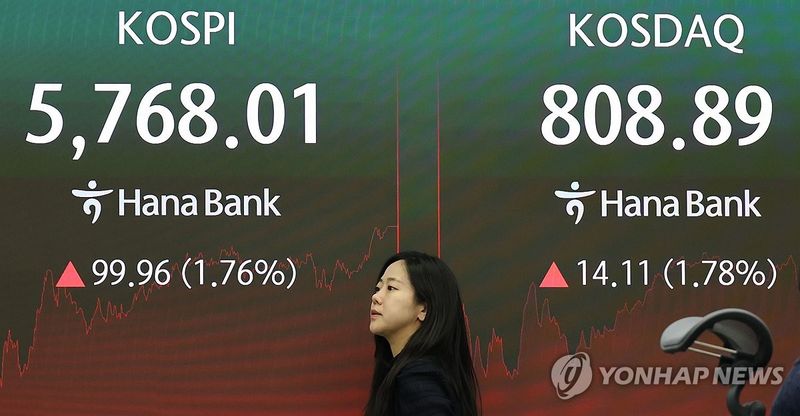
[Financial News] The KOSPI rebounded for a second consecutive trading day, but a brokerage analysis says it could fall to the 4,800 level if it declines further. The short-term support range is expected to be 5,100–5,340, and the market is unlikely to keep rising until improved profitability at AI companies is confirmed.
iM Securities: “If capitulation continues, the downside could reach 4,788”
On the 19th, the KOSPI closed at 5,768.01, up 99.96 points (1.76%) from the previous trading day. After falling for seven consecutive trading days from the 7th and dropping to the 5,500 level, the index rose for a second straight session.
In a report released on the 19th, Kim Jun-young, an analyst at iM Securities, said buying could emerge in the 5,100–5,340 range if the KOSPI falls again.
That range contains the 5,100 level, corresponding to a KOSPI price-to-book ratio (PBR) of 1; the 5,338 level, where about 78.6% of this year’s gains would be erased; and the 5,263 level, the intraday low on July 29. He said support to prevent further declines could form around this area.
He assessed that the 5,550–5,600 range, previously expected to provide support, had already given way. The KOSPI closed at 5,554.22 on the 15th and then rebounded, but given movements in the overnight futures market, the index likely fell below that range again.
He said the KOSPI could also fall below 5,100 if capitulation, with a large volume of selling pouring into the market, continues.
On the 15th, the KOSPI’s 20-day disparity index stood at -16.9%, among the lowest 0.4% of readings since 1999. The disparity index measures the difference between the current index and its average over the previous 20 days; the larger the negative reading, the faster the index has fallen over a short period.
The KOSPI’s 20-day disparity index has fallen below -15% on six occasions in the past. The median additional decline over the 40 trading days that followed was 13.8%.
If a decline of that magnitude were to recur this time, the KOSPI could fall to 4,788, the analysis said.
Analyst Kim also highlighted the possibility of buying emerging in the 4,900–5,000 range. This range coincides with a level at which about 61.8% of the KOSPI’s gains since April 2025 would be erased.
Analysis: “Oversold conditions signal entry into capitulation, not a market bottom”
He said it was difficult to conclude that the recent oversold conditions marked a stock-price bottom, and noted, “It is more reasonable to read the 20-day disparity index reaching -15% on the 15th as a signal that the market is entering a capitulation phase, rather than as a signal that it has bottomed.”
Past episodes have also seen stock prices plunge further after entering oversold territory. During the 2008 financial crisis and the COVID-19 pandemic in 2020, the KOSPI fell another 15–17% over two to three trading days after the disparity index dropped below -15%.
Last July, the index fell a further 17.8% over 12 trading days after recording the same level of disparity.
Analyst Kim assessed that risks to the domestic stock market are greater now than last July. In July, both the U.S. and South Korean stock markets fell, whereas the U.S. Nasdaq and large-cap tech stocks are currently holding at relatively high levels.
There are concerns that if the U.S. stock market undergoes another correction, the decline in the domestic market could be even steeper.
He advised investors to temper their expectations for the size of any gains, even if the rebound continues. iM Securities set an initial rebound target of 5,704, followed by a target of 6,000.
He said that rather than investing all at once in highly volatile sectors, investors should buy in several installments to prepare for further declines.
He said improved profitability in the AI industry is crucial for a sustained rise in the KOSPI. Although long-term U.S. interest rates have recently fallen, that should not be interpreted solely as a factor favorable to tech stocks.
The decline in interest rates is being driven more by falling real rates than by lower inflation expectations. iM Securities said this could be interpreted as a sign that investors’ expectations for the AI industry’s growth potential are weakening.
Uncertainty also remains over AI companies’ profitability. Competition among models is intensifying and fees for AI services are falling rapidly, while infrastructure costs for semiconductors, electricity and high-bandwidth memory (HBM) remain high.
Even if service usage increases, companies may struggle to generate sufficient returns relative to their large-scale AI investments if that growth does not offset the revenue lost as prices fall.
The analysis said the future share prices of Samsung Electronics and SK hynix will also be affected by how much profit AI companies that buy semiconductors are able to make.
iM Securities said it would be necessary to maintain a neutral stance on the domestic stock market until it becomes clear whether growth in revenue and usage at frontier AI companies developing cutting-edge models is sufficient to offset the impact of falling service prices.
Analyst Kim stressed, “For the KOSPI to rebound on a sustained trend, growth in AI companies’ revenue and profitability must be confirmed before falling interest rates can drive a recovery.”
[email protected] Han Seung-gon Reporter