“There’s less meat than in the seaweed soup a military cook made 40 years ago” ... Customer taken aback after ordering “beef seaweed soup” at a rest stop
- Input
- 2026-10-20 08:44:37
- Updated
- 2026-10-20 08:44:37
[The Financial News] A story about a customer disappointed by the small amount of meat in beef seaweed soup ordered at a highway rest stop has drawn attention.
Tipster: “When will highway rest areas finally improve?”
On the 18th, a post titled “Beef Seaweed Soup at a Highway Rest Stop” appeared on the online community Bobaedream.
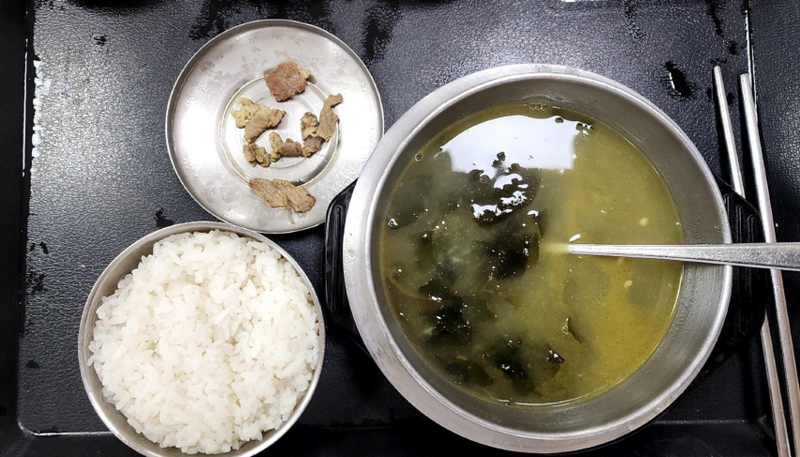
The author, identified as A, shared a photo of the beef seaweed soup and said, “I can’t bring myself to name the rest stop. I ordered beef seaweed soup and fished out the solid ingredients, but there was less meat than in the seaweed soup a military cook made for me 40 years ago.”
The photo shows small pieces of beef taken from the seaweed soup placed on the lid of a bowl of rice.
A criticized the government, saying, “It said it would improve food at highway rest areas. When will ordinary people be able to feel the difference?”
People who saw the post responded with comments such as, “At some point, I just stopped buying food at rest areas,” “At highway rest areas, I only use the restroom before leaving,” “As far as I can tell, nothing has changed yet,” and “That’s why I literally just rest at rest areas.”
“KEC → operator → tenant” multilevel contracts blamed for high food prices
The Ministry of Land, Infrastructure and Transport cited the multilevel contract structure—from the Korea Expressway Corporation to operating companies to tenants—as a reason for high food prices at rest areas last July.
The investigation found that rest-area operators took an average of 33% of tenant businesses’ sales in commissions, with the rate reaching as high as 51%. The Korea Expressway Corporation collected 13.9% of operators’ sales as rent.
The ministry said it would overhaul the operating system starting next year by establishing a public management company to contract directly with tenant businesses. If direct contracts are introduced, tenants’ average rent is expected to fall to 8–9% of sales.
The overhaul will be phased in, focusing on rest areas newly established this year or whose contracts are expiring. The plan is to cover around 100 locations next year and expand to 80–90% of rest areas nationwide—about 200 locations—by 2030.
However, since the changes will be phased in starting with rest areas whose contracts expire, it is expected to take time for visitors to notice a difference.
Criticism of food quality and the commission structure at highway rest areas also came up at the National Assembly Land, Infrastructure and Transport Committee’s audit of the Korea Expressway Corporation, the Korea Transportation Safety Authority, and others on the 8th.
Yeom Tae-young, a lawmaker from the Democratic Party of Korea, criticized the system, saying, “High rents and the commission structure are causing food quality and service standards to fall to a dismal level.”
[email protected] Kim Su-yeon Reporter